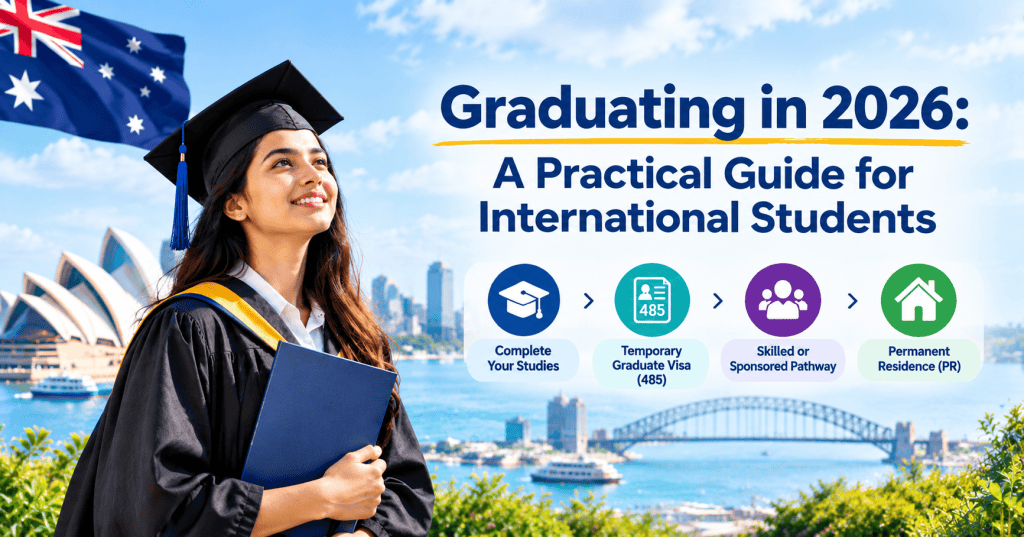
Graduating in 2026 from an Australian university or college can open several opportunities, but finishing your course does not automatically lead to permanent residency.
For international students, the period immediately after graduation can be important for building a pathway toward skilled migration, state or territory nomination, or employer sponsorship.
The Australian migration system includes several possible routes, and the right option depends on factors such as your occupation, qualifications, English ability, work experience, skills assessment, points and employment opportunities.
Key Points at a Glance
- Graduation itself does not provide permanent residency.
- The Temporary Graduate visa (subclass 485) can provide eligible graduates with time to gain Australian work experience.
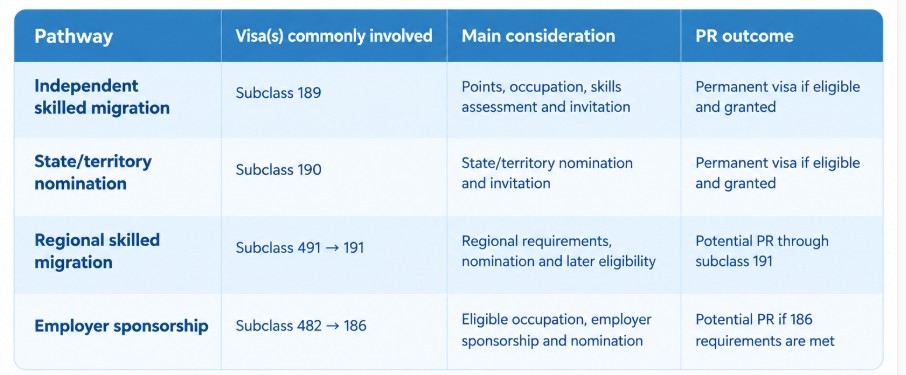
- Skilled migration may involve subclasses 189, 190 or 491.
- Employer sponsorship can provide another pathway through visas such as subclass 482 and, where eligible, subclass 186.
- Regional migration may create additional options for some graduates.
- An Expression of Interest (EOI) does not guarantee an invitation.
- Occupation lists, nomination requirements and visa policies can change.
1. What to Expect After Graduating in 2026
For many international students, the post-study journey can look something like:
Australian study → Graduate visa (if eligible) → Skilled employment → Skilled or sponsored pathway → Permanent residence
However, this is only one possible sequence.
Some graduates may be able to pursue another visa pathway without first relying on a subclass 485 visa, depending on their circumstances.
The important point is to start planning before your current visa expires rather than waiting until the final months of your post-study period.
2. Understanding the Temporary Graduate Visa
The Temporary Graduate visa (subclass 485) can be an important transition point for eligible international graduates.
For students graduating in 2026, understanding the Temporary Graduate visa and its eligibility requirements can be an important part of post-study planning.
It is a temporary visa rather than a permanent residency visa. For eligible graduates, it can provide an opportunity to remain in Australia after completing their studies and gain experience relevant to their future migration plans.
During this period, graduates may work on several aspects of their profile, including:
- Obtaining relevant professional experience
- Meeting English-language requirements
- Completing a relevant skills assessment
- Improving their points position
- Investigating state or territory nomination
- Finding an eligible sponsoring employer
- Considering regional employment opportunities
The specific subclass 485 requirements depend on the stream and the applicant’s circumstances, so graduates should check the current Department of Home Affairs requirements before relying on this pathway.
3. Skilled Migration: 189, 190 and 491
International students graduating in 2026 should consider how their occupation, skills assessment, English ability and points may affect their available skilled migration options.
One major group of pathways for skilled graduates involves the Skill Select system.
The Australian Government currently uses Skill Select for Expressions of Interest for:
- Skilled Independent visa (subclass 189)
- Skilled Nominated visa (subclass 190)
- Skilled Work Regional (Provisional) visa (subclass 491)
These pathways are invitation-based. An applicant generally needs to submit an EOI and wait to be invited before applying for the relevant visa.
This means meeting the minimum eligibility requirements does not necessarily mean an applicant will receive an invitation.
Subclass 189
The Skilled Independent visa can provide permanent residence for invited skilled workers who meet the applicable requirements.
For graduates, factors such as occupation, skills assessment, English, age and points can be important when preparing an EOI.
The Department of Home Affairs also publishes invitation-round information, demonstrating that invitation outcomes can vary between occupations and rounds.
Subclass 190
The Skilled Nominated visa involves nomination by an Australian state or territory.
This means graduates need to consider not only their own points and occupation but also the nomination requirements of the particular state or territory.
State and territory nomination programs can have their own criteria and allocation arrangements.
Subclass 491
The Skilled Work Regional visa provides a regional skilled migration option for eligible applicants.
For some graduates, studying or working in a regional area may therefore form part of a longer-term migration strategy.
The 491 is a provisional visa, while subclass 191 is one of the permanent residence pathways available to eligible regional visa holders who satisfy the relevant requirements. The Department of Home Affairs lists subclass 191 among Australia’s permanent work visas.
4. Employer Sponsorship: Another Route After Study
Not every graduate will pursue a points-tested pathway.
Another possibility is employer-sponsored migration.
A simplified example can be:
Study → Graduate visa → Skilled employment → Subclass 482 → Potential subclass 186 pathway
The Skills in Demand visa (subclass 482) is a temporary employer-sponsored visa. The relevant occupation and other requirements depend on the applicable stream and current legislation.
The Department of Home Affairs currently identifies occupation specifications for subclasses 482 and 186 in its skilled migration legislative instruments.
For a graduate considering sponsorship, finding a job is only one part of the process.
You also need to consider whether:
- The occupation is eligible.
- You meet the visa requirements.
- The employer is able and willing to sponsor.
- The position meets the relevant requirements.
- The employer can nominate you.
- You satisfy the requirements for any later permanent visa pathway.
A job offer therefore does not automatically create a PR pathway.
5. Why Your Occupation Matters
Your course title alone does not determine your migration options.
What matters can include the occupation you nominate, the skills assessment authority, your qualifications, employment history and the visa subclass you are considering.
The Department of Home Affairs publishes occupation and assessing-authority information for different skilled visa programs. The applicable occupation lists can differ between visa subclasses.
Planning Your Career Direction
Your post-study career choices can influence the options available to you later. Look beyond simply finding any graduate job and consider whether the role is connected to your qualification and nominated occupation. Building experience in a relevant field may help you develop a stronger professional profile over time. Keeping records of your employment, qualifications and professional achievements can also make future applications easier when you become eligible for a particular pathway.
For this reason, students should investigate migration-related requirements before choosing a course, rather than assuming that any Australian qualification will lead to skilled migration.
6. English Can Affect Your Migration Strategy
English proficiency can be relevant to several parts of a graduate’s migration planning.
Depending on the pathway, a stronger English result may affect eligibility or points.
It can also be useful professionally, particularly where registration or employment requirements apply.
Instead of treating an English test as something to complete only when preparing a visa application, graduates can consider it as part of their broader migration planning.
7. Skills Assessment: Don’t Leave It Until the Last Minute
A skills assessment can be an important part of skilled migration.
The relevant assessing authority depends on the occupation and visa pathway.
The Australian Government’s occupation information identifies different assessing authorities for different occupations.
Before assuming that your Australian degree automatically qualifies you for a particular occupation, check:
- Which occupation matches your actual skills and employment?
- Which authority assesses that occupation?
- What qualifications are required?
- Is relevant work experience required?
- Does your degree satisfy the applicable criteria?
- How long could the assessment process take?
Planning these issues early can help prevent avoidable delays later.
8. Regional Australia May Provide Additional Options
Regional migration is another area graduates can investigate.
For eligible applicants, regional pathways can include subclass 491 and other regional visa options.
However, moving to a regional location should not be based solely on the assumption that it Graduating in 2026 guarantees PR.
Before relocating, check the current requirements for:
- The occupation
- State or territory nomination
- Regional residence
- Employment
- Visa conditions
- Future permanent residence eligibility
The Department of Home Affairs currently lists subclass 491 among the skilled regional visa programs and subclass 191 as a permanent regional visa.
9. Graduating in 2026-Your PR Strategy Should Be Flexible
One of the biggest mistakes graduates can make is building their entire migration plan around one visa subclass.
For example, a student might initially expect:
485 → 189
But after graduation, circumstances could change.
Their options might instead involve:
485 → 190
or
485 → 491 → 191
or potentially:
485 → 482 → 186
The important issue is not following one predetermined sequence. It is understanding which pathways you may be eligible for and monitoring how your circumstances affect those options.
10. What Should You Do During Your Graduate Visa Period?
Rather than simply waiting for the next visa opportunity, graduates can use this period to strengthen their overall profile.
Build relevant work experience
Try to obtain employment connected with your nominated or intended occupation where possible.
Improve your English
If a higher English result could benefit your pathway, investigate the applicable test and scoring requirements early.
Check your skills assessment
Do not assume that your qualification automatically produces a positive assessment.
Monitor state nomination programs
State and territory criteria can change, so regularly check the requirements applicable to your occupation and circumstances.
Research employers
If employer sponsorship may be an option, understand which employers and occupations are relevant to your field.
Keep your documents organised
Maintain records of:
- Employment contracts
- Payslips
- Tax documents
- Position descriptions
- Academic records
- English test results
- Skills assessment documents
- Professional registration
- Identity documents
Good record-keeping can make future applications easier.
11. Don’t Confuse an EOI With a Visa Application
This is an important distinction for skilled migration applicants.
An Expression of Interest is not the same as lodging a visa application.
The Department of Home Affairs states that applicants submit an EOI through SkillSelect and, if invited, can then proceed with a visa application. Once invited, applicants have 60 days to submit the visa application.
Therefore, submitting an EOI should not be treated as a guarantee of permanent residence.
Invitation outcomes can depend on the applicable program settings, occupation, competition and other factors.
12. A Simple Planning Timeline for Graduates who Graduating in 2026
For graduates graduating in 2026, early planning can help identify which requirements need to be addressed before applying for a future visa pathway.
A practical approach could look like this:
Before graduation
Check your occupation → Understand skills assessment → Review English requirements → Research possible pathways
After graduation
Determine 485 eligibility → Gain relevant experience → Improve your profile → Monitor nomination opportunities
During skilled employment
Update your EOI where applicable → Explore state nomination → Consider employer sponsorship → Maintain supporting documents
When eligible
Receive invitation or nomination → Lodge the appropriate visa application → Meet all applicable requirements
This should be treated as a planning framework rather than a guaranteed sequence.
13. Common Mistakes International Graduates Should Avoid
Choosing a course without checking the occupation outcome
A course may be academically suitable but may not lead to the occupation you expect for migration purposes.
Assuming the 485 guarantees PR
The 485 is temporary. It does not itself provide permanent residence.
Relying on the minimum points threshold
Being technically eligible for a points-tested visa does not mean you will necessarily receive an invitation.
Ignoring state-specific requirements
A state or territory may have criteria that differ from another jurisdiction.
Waiting until your visa is close to expiry
Migration planning can involve skills assessments, English tests, employment evidence and other documentation. Starting late can limit your options.
Assuming an employer will sponsor you
An employer may offer you a job without being willing or able to sponsor you.
14. How to Think About Your Australian PR Plan
Instead of asking:
“Which visa will give me PR?”
a more useful question may be:
“What profile do I need to build to keep several eligible pathways available?”
That profile could involve:
Relevant qualification + eligible occupation + English + skills assessment + relevant employment + competitive points + state nomination or employer sponsorship
Not every graduate will need every component.
Your pathway will depend on your individual circumstances and the rules applying when you become eligible.
Frequently Asked Questions
1. What should international students do after graduating in 2026?
International students graduating in 2026 should review their post-study options, including the Temporary Graduate visa, skilled migration, state or territory nomination, and employer-sponsored pathways. The appropriate option depends on individual eligibility and circumstances.
2. Does graduating from an Australian university guarantee permanent residency?
No. Completing an Australian qualification does not automatically lead to permanent residency. Graduating in 2026must meet the requirements of the visa or migration pathway they are considering.
3. Can graduates apply for a Temporary Graduate visa after completing their studies?
Eligible graduates may be able to apply for a Temporary Graduate visa (subclass 485). Eligibility depends on the applicable stream and the applicant’s circumstances, so current requirements should be checked before applying.
4. Can international students graduating in 2026 pursue skilled migration?
Yes, eligible graduates may consider skilled migration pathways such as subclasses 189, 190 and 491. Factors can include occupation, skills assessment, English ability, age, points and applicable nomination requirements.
5. Can an employer sponsor an international student after graduating in 2026?
Employer sponsorship may be another option for eligible graduates. However, having a job offer does not automatically create a permanent residency pathway. The occupation, visa requirements, employer sponsorship and nomination requirements must all be considered.
6. When should international students start planning after graduating in 2026?
International students should start planning their next steps before their current visa expires. Reviewing occupation requirements, English, skills assessment, employment and possible migration pathways early can help avoid delays.
7. Does a job offer guarantee permanent residency in Australia?
No. A job offer does not automatically create a permanent residency pathway. Graduates also need to consider whether the occupation is eligible, whether they meet the visa requirements, and whether the employer is able and willing to sponsor them.
8. Can regional Australia provide additional options for graduates?
Regional migration may provide additional options for eligible graduates. Depending on their circumstances, studying or working in a regional area may form part of a longer-term migration strategy.
Final Thoughts
Graduating in 2026 from an Australian university or college can be the beginning of a new journey for international students, rather than the end of their study plans. Graduating in 2026 gives students an opportunity to carefully consider their next steps and explore suitable post-study options.
After graduating in 2026, students can focus on gaining relevant professional experience, understanding their occupation, improving their English, exploring state or territory nomination and considering employer-sponsored opportunities.
There is no single pathway that works for every international student graduating in 2026. Skilled migration programs, occupation requirements, nomination arrangements and employer-sponsored rules can change over time. For international students graduating in 2026, reviewing migration options early can help with planning. It is important to regularly check the requirements that apply to your circumstances and obtain professional migration advice where appropriate
Plan early, keep multiple options open, and make decisions based on the rules that apply to your own circumstances at the time of application.
Shri Krishna Consultants specialises in helping applicants navigate exactly this kind of complex, occupation-specific migration environment. Connect with our team to get a clear, honest assessment of where your strongest pathway lies — not based on what used to work, but based on where the Australian migration system has genuine capacity in 2026–2027.
This article is for general information only and does not constitute migration advice. Australian visa requirements, occupation lists, nomination criteria and program settings can change. Applicants should check current Department of Home Affairs requirements and obtain professional advice before making immigration decisions.