Executive Summary
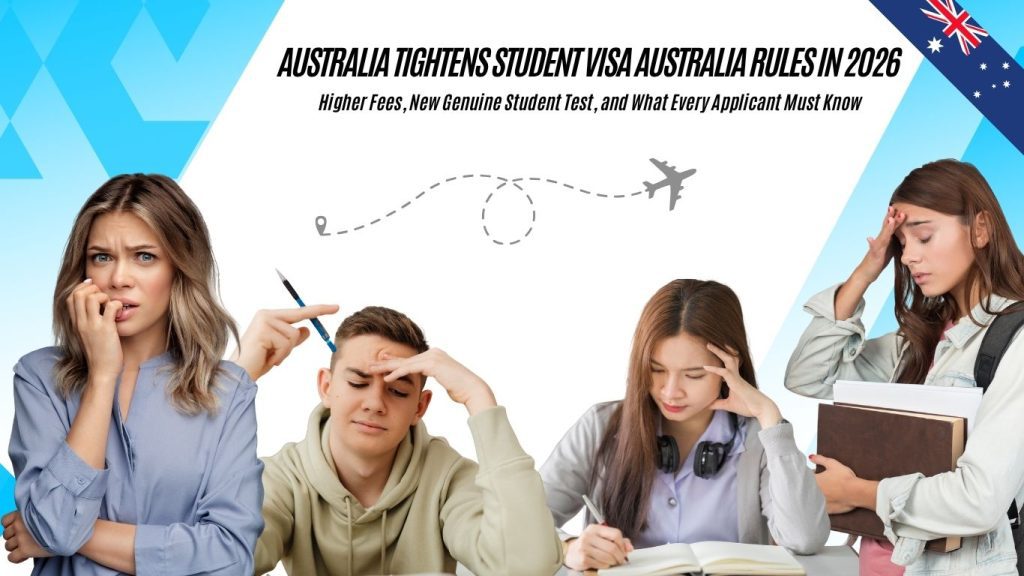
Student Visa Australia – Australia’s student visa landscape changed fundamentally on 8 February 2026. The Subclass 500 application fee increased to AUD 2,000 — nearly double the previous rate — and the long-standing Genuine Temporary Entrant (GTE) statement was replaced by the new Genuine Student (GS) test, the most significant procedural overhaul in a decade. India has been reclassified to Australia’s highest student visa risk tier, triggering mandatory additional documentation and longer processing times for Indian applicants. The 2026 visa cap has been lifted to 295,000 places — up from 270,000 — but the Department of Home Affairs has made clear that quality screening is intensifying in parallel with volume. Generic, copy-paste personal statements no longer pass. Applicants must now provide specific, granular evidence of study intent, career plans, and ties to their home country. For international students — especially those from India and other high-scrutiny countries — the message is clear: professional, well-documented applications submitted at least eight weeks before course start dates are no longer optional. They are essential.
1. What Changed on 8 February 2026 — The Full Picture
The 8 February 2026 date will be remembered as a turning point in Australian international education policy. On that day, three interconnected changes came into effect simultaneously — changes that, taken together, represent the most significant tightening of the Australian student visa framework in over a decade.
The first change was the Subclass 500 application fee increase to AUD 2,000. The second was the replacement of the Genuine Temporary Entrant (GTE) statement with the new Genuine Student (GS) test. The third was the reclassification of India to Australia’s highest student visa risk tier, bringing it into alignment with several other countries that trigger mandatory additional scrutiny throughout the application process.
These changes did not emerge from a vacuum. They are the government’s direct response to a series of high-profile student visa fraud cases that came to light in 2025, involving fraudulent documentation, fabricated enrolment intentions, and instances where student visa holders had no genuine intention to study. The government’s position — communicated directly by the Home Affairs minister — is that Australia’s education reputation is worth protecting, and that deterring non-genuine applicants through higher fees and more rigorous assessment serves the long-term interests of genuine students, education providers, and the broader public.
A Home Affairs spokesman confirmed that the combined effect of the fee increase and the GS test is intended to raise the quality of the student visa cohort, not to reduce its overall size. The 295,000 cap increase is consistent with this framing: Australia wants more international students, but specifically more of the right international students — those with genuine study intent, clear career plans, and realistic pathways that connect their proposed study to their life and work context.
For students whose applications are thorough, honest, and professionally prepared, these changes are manageable. For students who were relying on generic documentation, informal support, or under-prepared applications, the new environment is genuinely difficult. Understanding exactly what the changes require — and building an application that meets those requirements from the first document to the last — is the only strategy that works in 2026.
2. The Genuine Student Test — How It Differs from the GTE Statement
The replacement of the Genuine Temporary Entrant statement with the Genuine Student test is the change that immigration lawyers and education agents have described as the most significant shift in a decade — and it is worth understanding precisely what has changed and why it matters so much.
The former GTE statement asked applicants to demonstrate that their primary intention was to come to Australia temporarily for study, and that they had genuine reasons to return to their home country after completing their course. It was a written statement — often one to three pages — that the applicant prepared, typically with the assistance of an education agent or consultant. Over time, the format became so standardised that a significant proportion of statements were effectively templates with minor personalisation. Case officers became familiar with this pattern, and the GTE statement lost much of its discriminatory power as a genuine screening tool.
The new Genuine Student test is structured differently at its foundation. Rather than asking applicants to make assertions about their intentions, it requires them to provide specific, verifiable evidence that demonstrates genuine study purpose. The assessment covers four interconnected areas.
Study intent and course relevance. Applicants must explain, with specificity, why they have chosen the particular course and institution they are applying to enrol in. Generic statements about “wanting to experience Australian education” or “seeking international qualifications” are insufficient. The case officer will be assessing whether the course logically follows from the applicant’s prior education, whether the institution’s reputation and course content are plausible given the applicant’s stated goals, and whether the level of study (diploma, bachelor, master) is appropriate for the applicant’s existing qualifications.
Career pathway clarity. Applicants must describe specific career goals that connect their proposed study to a realistic employment outcome — either in Australia on a post-study work visa or in their home country. Vague career ambitions are not sufficient. The GS test requires applicants to demonstrate that they understand what the qualification they are pursuing actually enables them to do professionally, and how that aligns with their personal circumstances.
Economic circumstances and financial capacity. Applicants must demonstrate they have genuine financial capacity to fund both their study and their living costs in Australia. The financial requirements for 2026 include documented evidence of at least AUD 29,710 per year for living costs plus tuition fees plus travel expenses. The GS test looks at this not just as a document check but as part of the overall coherence of the application — does the financial capacity claimed make sense given the applicant’s background and circumstances?
Home country ties. Applicants must provide evidence of meaningful connections to their home country that create a genuine incentive to return after study — family, property, employment prospects, community obligations, or other documented ties. The strength of home country ties has always been relevant to student visa assessment, but under the GS test it is a more explicitly evaluated criterion rather than an implicit background consideration.
Education agents across Australia have been unambiguous in their advice: copy-paste GS statements prepared from templates will fail. Applications must be individually constructed, specific to the applicant’s actual circumstances, and supported by documentation that corroborates every material claim. This is a higher preparation standard than the GTE era required — and it is a standard that rewards applicants who invest in professional, thorough application preparation.
3. The AUD 2,000 Fee — Who Pays, Who Is Exempt, and What It Signals
The increase of the Subclass 500 student visa application fee to AUD 2,000 is both a practical financial change and a policy signal. Understanding both dimensions helps applicants approach it with appropriate context.
From a practical standpoint, the fee applies to new Subclass 500 applications lodged from 8 February 2026. Students who had already lodged their applications before that date are not subject to the increased fee. Students already in Australia who are applying for a subsequent student visa — for example, to extend their studies or change courses — are subject to the GS test requirement but may have different fee arrangements depending on the specific circumstances of their application.
The fee increase is significant for families planning an Australian education journey from India or other source countries. For a student considering a three-year bachelor’s degree, the application fee alone represents a meaningful upfront cost — before tuition, living expenses, airfares, and OSHC are factored in. For employers or institutions sponsoring cohorts of students, the cumulative cost impact is substantial. A cohort of 150 intern or scholarship students, for instance, faces an additional AUD 300,000 in application fees compared with the pre-February 2026 structure.
The policy signal embedded in the fee increase is equally important. High application fees serve as a deterrent to non-genuine applicants — specifically those who view the student visa as a low-cost mechanism for entering Australia for purposes other than study. By raising the financial stake of a visa application, the government increases the cost of non-genuine applications and reduces the incentive to attempt them. Genuine students who can demonstrate the financial capacity required by the GS test — the AUD 29,710 annual living cost requirement plus tuition and travel — will typically have the resources to absorb the AUD 2,000 fee without it representing a prohibitive barrier.
For applicants seeking student visa australia guidance, understanding how the fee fits into the total cost picture for an Australian education is an important early planning step. Shri Krishna Consultants provides clear, accurate fee and cost guidance as part of every student visa consultation.
4. India’s Reclassification to Highest Risk Tier — What It Means Practically
Of all the February 2026 changes, India’s reclassification to Australia’s highest student visa risk tier is the one with the most immediate practical implications for the largest group of applicants we serve.
Australia’s student visa risk framework classifies source countries into tiers based on assessed visa non-compliance rates — including overstay rates, fraudulent documentation rates, and instances of visa condition breaches. Higher-tier classifications trigger additional document requirements, longer processing times, and more intensive case officer scrutiny. India’s reclassification to the highest tier reflects data accumulated by the Department of Home Affairs through 2024 and 2025, including the visa fraud cases that motivated the broader February 2026 reforms.
For Indian applicants, the practical consequences of this reclassification are specific and significant.
Additional documentation requirements. Indian applicants are now required to provide documentation packages that go beyond what lower-risk applicants must supply. This includes more detailed financial documentation, additional evidence of home country ties, employer or institutional verification letters, and in some cases biometric requirements that apply specifically to high-risk tier applicants.
Longer processing times. Applications from high-risk tier countries are subject to more intensive case officer review, which translates to longer average processing times. Where a student from a lower-risk country might receive a Subclass 500 decision in four to six weeks, Indian applicants should currently budget for eight to twelve weeks or longer — and should plan their application timeline accordingly.
Higher documentation quality requirements. The combination of the GS test and the high-risk tier classification means that Indian applicants face a double layer of scrutiny. Every document submitted must be current, accurate, and specifically relevant to the claims being made. Inconsistencies between documents — even minor ones — are more likely to be identified and to cause delays or adverse outcomes in a high-scrutiny assessment environment.
For Indian students who have received offers from Australian institutions and are now preparing their applications, the message is not discouraging — it is practical. India sends more students to Australia than almost any other country, and many thousands of Indian students successfully obtain Subclass 500 visas every year. The higher tier classification does not make approval impossible. It makes professional, thorough, individually tailored application preparation even more important than it already was. Working with a registered immigration agent near me who understands the specific documentation requirements for high-risk tier applicants is the most effective way to manage this additional complexity.
Understanding the student visa subclass 500 conditions and how to satisfy them fully — including the academic progression, OSHC maintenance, and working hour conditions — is also part of the preparation that helps case officers assess an application favourably. Applicants who can demonstrate they understand and intend to comply with visa conditions signal genuine study intent more credibly than those who cannot.
5. The 295,000 Cap — More Places But Stricter Standards
The increase in the 2026 student visa cap to 295,000 places — up from 270,000 in the previous year — might seem at odds with the tightening of entry requirements. In fact, it reflects a coherent policy position: Australia wants more international students, but specifically more genuine international students who meet the higher standards being introduced.
This is not contradictory. It is selective growth — the same framework that many high-performing international education markets use to expand their intake while protecting the integrity of their visa system. A larger cap with stricter screening should, in theory, produce a larger cohort of genuinely enrolled, academically engaged, visa-compliant international students. Whether this delivers the intended outcome over the next 12 to 24 months will depend on how consistently the GS test and risk tier documentation requirements are applied.
For applicants, the cap increase is relevant context for two reasons. First, it confirms that Australia’s policy intent is not to reduce international student numbers — it is to improve the quality and authenticity of the student visa cohort. Genuine applicants with well-prepared applications are not disadvantaged by the new regime; in fact, they benefit from reduced competition from non-genuine applications that the new framework is designed to filter out. Second, the cap increase signals that high-demand fields — including healthcare, STEM, education, and trades — will continue to have substantial student visa allocation available for qualified applicants.
For students applying from India through Shri Krishna Consultants, we actively monitor cap utilisation by occupation and study level, and can advise on the most favourable application timing to ensure our clients are applying when cap space is available for their specific course category.
6. What Case Officers Are Now Looking For
The shift to the Genuine Student test has changed what case officers actually examine when assessing a Subclass 500 application. Understanding this from the case officer’s perspective — rather than the applicant’s — is one of the most useful reframes in preparing a strong application.
Case officers are trained to assess the internal coherence of an application. Does the course make sense for this person? Does the financial picture add up? Are the home country ties genuine and specific? Is the career pathway realistic given the applicant’s background? Can they find any inconsistencies between the information provided and the documents submitted?
In the post-GTE era, case officers were often assessing statements against templates — recognising the standard formats and looking for red flags. In the GS test era, they are assessing narratives against evidence. A statement that says “I want to study nursing because Australia is renowned for healthcare education” is a statement. A statement that says “My background in community healthcare in Punjab has prepared me for clinical training, and the specific simulation laboratory program at [Institution] offers the practical exposure I need to qualify as a registered nurse and return to contribute to the healthcare gap in my region” is a narrative supported by a context. The first raises no specific flags but also provides no specific evidence of genuine intent. The second tells a coherent, specific, verifiable story.
Case officers in 2026 are also paying particular attention to the relationship between the applicant’s previous study and the course they are applying for. A logical academic progression — secondary school certificate to relevant bachelor’s degree, bachelor’s degree to relevant master’s program — is inherently more credible than a sharp pivot from an unrelated field without explanation. Where course changes or apparent pivots exist, they must be explained specifically and supported with documentation — work history, employer letters, professional development records — that provides the context that makes the pivot logical.
For students in Melbourne’s western suburbs who have australian visa for international students questions about how their specific study background fits the GS test requirements, Shri Krishna Consultants’ consultations include a detailed assessment of how your application narrative should be structured.
7. How Universities Are Responding to the New Rules
Australian universities have not been passive observers of the February 2026 changes. They have a direct institutional interest in their international students receiving visa approval — and they have moved quickly to update their processes to better support GS test compliance.
The most visible university-level change has been the redesign of offer letters and enrolment confirmation documents. Under the old GTE framework, offer letters were largely administrative — they confirmed the course, start date, fees, and CRICOS registration. Under the GS test framework, universities have begun incorporating explicit course relevance statements into their offer documentation — explaining how the program supports the career pathways the institution’s research shows are common among students from specific source countries.
Several major universities have also introduced structured GS test support programs for newly admitted international students, providing guidance on how to document study intent and career plans in a way that specifically addresses the assessment criteria. This institutional support is most developed at institutions that already had strong international student support infrastructure — and is one reason why choosing an institution with robust international student services is now even more important than it was previously.
For applicants who are applying to apply for australia student visa through Shri Krishna Consultants, we work directly with your institution’s international admissions team where appropriate to ensure that all supporting documentation — including offer letters and enrolment confirmations — is consistent with the GS test requirements and strengthens rather than undermines your application.
8. Impact on Employers and Graduate Talent Pipelines
The February 2026 changes do not only affect students — they have meaningful downstream consequences for Australian employers who rely on international graduate talent to fill roles in STEM, healthcare, engineering, and other skilled shortage areas.
The most immediate impact is on recruitment timelines. With longer processing times for high-risk tier applicants — including the large Indian student cohort that forms a major part of many employers’ graduate pipelines — the reliable prediction of when an international graduate can commence employment has become more complex. Employers who previously budgeted eight to ten weeks from offer to start date for international graduates now need to allow for twelve to sixteen weeks in many cases.
The second impact relates to the profile of students who successfully navigate the new system. Students who can demonstrate the academic and career narrative coherence required by the GS test — those with clear, well-documented study plans and career pathways — are precisely the students who make the most effective employees. The filtering effect of the GS test, over time, should produce a graduate cohort that is more academically focused and career-oriented than the cohort that pre-February 2026 permissiveness allowed. For employers, this is a medium-term benefit even if it creates short-term recruitment complexity.
For graduates already in Australia on a student visa australia who are approaching the transition to a temporary graduate visa australia and then potentially permanent residency, the changes reinforce the importance of maintaining a clear, documented career narrative throughout the entire study and post-study period — not just at the initial visa application stage.
9. STEM and Healthcare Students — Why They Remain Protected
The February 2026 reforms have a de facto sectoral bias that is worth understanding explicitly. The tightening of the Genuine Student test and the reduction of post-study work rights for certain non-STEM graduates effectively concentrates post-study work visa access on exactly the occupational groups that Australia’s skills shortage list prioritises.
Healthcare graduates — registered nurses, allied health professionals, and medical practitioners — retain strong post-study work rights and remain among the most actively sponsored skilled migrants in the country. The combination of an ageing population, chronic domestic workforce shortages, and strong state nomination support makes healthcare one of the most secure migration pathways available for international students, even as the entry requirements for the student visa tighten.
STEM graduates — software engineers, data scientists, civil engineers, and cybersecurity specialists — similarly retain full access to the Subclass 485 Temporary Graduate Visa and benefit from the Specialist Skills stream that rewards high-earning technology and engineering professionals with priority processing.
For students choosing between a non-STEM business course with diminishing post-study work rights and a STEM or healthcare qualification with strong continued access to the post-study work pathway, the calculation has shifted materially in favour of the skills-aligned choice. Students considering permanent residency courses in australia — those connected to occupations on the australia skilled occupation list — are making a qualitatively different calculation than students choosing courses without this alignment.
10. Students Already in Australia — What Changes for You
For international students who are already in Australia on a Subclass 500 visa granted before 8 February 2026, the changes apply with some important distinctions.
The higher AUD 2,000 fee does not apply retroactively to existing visa holders. Students who lodged their current visa application before the fee change are not required to pay the difference. However, the new fee does apply to any subsequent student visa application — including applications to extend study, change courses, or re-apply after a visa expiry.
The Genuine Student test applies to all new Subclass 500 applications regardless of whether the applicant is applying offshore or is already in Australia. This means that students approaching the end of their current course who need to apply for a new student visa to continue or extend their studies must satisfy the GS test requirements for that new application — and should prepare accordingly rather than assuming that prior visa approval makes a new application straightforward.
Understanding the student visa 500 working hours conditions that currently apply to your existing visa — including the 48 hours per fortnight during term — remains important for maintaining compliance. Any condition breach in your existing visa record can complicate a subsequent application by creating an adverse compliance history that a case officer will consider in their GS test assessment.
For students in Australia on a student visa extension australia pathway or managing a course change, Shri Krishna Consultants provides current, accurate guidance on how the new requirements apply to your specific situation.
11. The Post-Study Work Visa Landscape After February 2026
The February 2026 student visa changes do not directly alter the Subclass 485 Temporary Graduate Visa conditions, but they do interact with the broader post-study work visa landscape in ways that are important for students to understand.
The Subclass 485 — the temporary graduate visa that allows international graduates to live and work in Australia after completing their studies — continues to be available to graduates who meet the eligibility criteria, including the 485 visa english requirements and the Australian Study Requirement.
However, proposed changes to post-study work rights for certain non-STEM graduates — flagged by the government alongside the February 2026 student visa tightening — are expected to reduce access to the 485 for graduates of general business, hospitality management, and liberal arts programs that do not align with the skills shortage occupation list. STEM, healthcare, and trade graduates are specifically protected from any reduction in post-study work rights.
For students who are planning their Australian journey with the 485 temporary graduate visa as a critical bridge between graduation and permanent residency — particularly Indian students pursuing PR in Australia from India pathways — choosing a course that secures access to the full 485 entitlements is now more strategically important than ever.
12. Before and After — Student Visa Rules Comparison Table
| Element | Before 8 February 2026 | From 8 February 2026 |
|---|---|---|
| Subclass 500 Application Fee | AUD 710 | AUD 2,000 |
| Genuineness Assessment | Genuine Temporary Entrant (GTE) statement | Genuine Student (GS) test — structured, evidence-based |
| Statement Format | Written statement — largely template-acceptable | Specific, individually tailored, document-supported narrative |
| India Risk Tier | Lower risk tier | Highest risk tier — additional documentation and scrutiny |
| Annual Student Visa Cap | 270,000 places | 295,000 places |
| Processing Time — High-Risk Countries | 4–8 weeks typical | 8–16 weeks expected |
| STEM/Healthcare Post-Study Work Rights | Unchanged | Protected — no reduction |
| Non-STEM Post-Study Work Rights | Full 485 access | Under review — potential reduction for non-skilled occupations |
| Document Category | What Was Sufficient Before | What Is Required Now |
|---|---|---|
| Study Intent Statement | Template GTE statement, 1–2 pages | Specific GS narrative with course relevance evidence |
| Financial Evidence | Bank statements showing required balance | Bank statements + source of funds + capacity context |
| Career Plans | General career direction statement | Specific career pathway with connection to proposed study |
| Home Country Ties | Basic family/property reference | Documented ties — employment, property, family obligations |
| Institution Choice Rationale | General institution reputation reference | Specific course content/feature relevance to stated goals |
| Academic Progression | Prior qualification listed | Logical connection between prior study and new course explained |
13. The 8-Week Rule — Why Your Timeline Must Change
One of the most immediately actionable recommendations for any student applying for an Australian student visa in 2026 is to change your application timeline. The old heuristic of lodging a student visa application four to six weeks before a course start date is no longer reliable for any applicant — and for high-risk tier applicants, including all Indian students, it is actively dangerous.
Immigration lawyers and registered migration agents across Australia have been advising clients consistently: lodge your student visa application at least eight weeks before your intended course start date. For high-risk tier applicants, twelve weeks is a more prudent target. This buffer accommodates the longer processing times now associated with high-risk tier applications, allows time for any requests for additional documentation that case officers may issue, and ensures that a processing delay does not cascade into a missed course start and the disruption — financial and personal — that entails.
For students applying through Shri Krishna Consultants, we proactively manage application timing as part of our service — ensuring that every application is lodged with sufficient lead time to allow for the complete assessment process under the new framework. We also monitor Department of Home Affairs processing time data in real time, and adjust our timeline recommendations as processing patterns evolve through 2026.
The eight-week rule also has implications for course selection timing. Students who receive offers and then spend several weeks deciding whether to accept, gathering documentation, or seeking secondary advice are compressing a timeline that no longer has the flexibility it once did. Once an offer is received, the application preparation process should begin immediately.
14. How Shri Krishna Consultants Helps You Navigate the New System
The February 2026 student visa changes have made professional, experienced migration support more valuable than at any point in the past decade. The GS test’s requirement for specific, individually tailored, document-supported narratives is precisely the kind of complex, high-stakes preparation that benefits most from working with people who do it every day.
At Shri Krishna Consultants, our team of australian registered migration agents provides comprehensive support at every stage of the student visa application process under the new framework. Our services include personalised GS test narrative preparation that tells your specific story — not a template — with full document cross-checking to ensure consistency and credibility. We provide detailed guidance on the documentation required for high-risk tier applicants, including Indian students, to ensure that every required element is present and properly formatted.
We serve clients across Melbourne’s western suburbs — Werribee, Tarneit, Point Cook, Hoppers Crossing, and Williams Landing — and provide guidance to students and families in India who are preparing their Australian study journey from the beginning. As immigration consultant near me advisers who understand the local community as well as the migration system, we provide support that generic online services cannot replicate.
Whether you are a student preparing your first Subclass 500 application, a graduate managing your student visa extension or temporary graduate visa australia application, or a family in India asking how to apply for Australian student visa from India under the new rules — Shri Krishna Consultants is ready to help. Contact us today to book a consultation and ensure your application is built to the standard the new system demands.
15. Frequently Asked Questions (FAQs)
What is the Genuine Student test and how does it differ from the GTE statement?
The Genuine Student (GS) test replaced the Genuine Temporary Entrant (GTE) statement on 8 February 2026. While the GTE was a written statement — often template-based — the GS test requires specific, evidence-based demonstration of study intent, career plans, financial capacity, and home country ties. Generic statements no longer satisfy case officer requirements. Each element must be supported by documentation.
How much is the Subclass 500 student visa fee in 2026?
The Subclass 500 application fee increased to AUD 2,000 from 8 February 2026. This applies to all new applications lodged from that date. Students who lodged their application before 8 February are not subject to the increased fee for that application, but will pay AUD 2,000 for any subsequent student working visa australia application.
Does India’s reclassification to the highest risk tier mean my application will be refused?
No. India’s reclassification means Indian applicants face additional documentation requirements and longer processing times — not automatic refusals. Thousands of Indian students continue to receive Subclass 500 approvals. What the reclassification means is that applications must be more thoroughly prepared, more specifically documented, and lodged earlier than previously required. Working with a best immigration agent in melbourne who understands high-risk tier requirements is the most effective response.
How long will my student visa application take to process in 2026?
Processing times vary by applicant country and individual circumstances. For Indian applicants at the highest risk tier, budget 8 to 12 weeks from lodgement to decision — and lodge at least 8 weeks before your course start date, ideally 12 weeks. For lower-risk tier applicants, 4 to 8 weeks remains a reasonable estimate, though individual cases vary.
I am already in Australia on a student visa. Do the changes affect me?
The higher AUD 2,000 fee does not apply to your current visa. However, the Genuine Student test applies to all new Subclass 500 applications — including applications to extend study or change courses. Understanding the new rules for course change and how the GS test applies to your next application is important planning for students currently in Australia.
Do STEM and healthcare students still have access to the Subclass 485 post-study work visa?
Yes. STEM and healthcare graduates retain full access to the 485 temporary graduate visa and its post-study work rights. The potential reduction in post-study work rights being discussed by the government is specifically targeted at non-STEM, non-skills-shortage graduates. Students in nursing, engineering, IT, and healthcare are specifically protected.
Can I still apply for the student visa if I want to study a non-STEM course?
Yes. The GS test applies to all Subclass 500 applications regardless of course type. Non-STEM courses remain eligible for the student visa — the additional scrutiny applies equally to all applications. The distinction is in post-study work rights, where non-STEM graduates may face reduced 485 access, not in the student visa approval process itself.
What should my first step be if I am planning to apply for an Australian student visa in 2026?
Book a consultation with a migration agent near me as early as possible — ideally at least three to four months before your intended course start date. Use this time to prepare your GS documentation, gather financial evidence, document your home country ties, and build the specific, coherent career narrative the new system requires. Do not start the application process four weeks before your course begins.
16. Final Thoughts
The 8 February 2026 student visa changes are not a reason to abandon your plans for an Australian education. They are a reason to take those plans more seriously and prepare for them more thoroughly than you may have intended.
Australia remains one of the world’s most sought-after destinations for international students. Its universities are genuinely excellent. Its economy provides real graduate employment opportunities. Its migration pathways — for those who choose the right course, build the right experience, and navigate the system correctly — remain among the most accessible routes to permanent residency available anywhere in the world.
What has changed is the standard of entry. Australia is now in the same high-scrutiny club as the United States, Canada, and the United Kingdom — countries that ask more of their applicants, process more carefully, and maintain higher documentation standards as a result. This is not a hostile environment for genuine students. It is an environment that rewards preparation.
Shri Krishna Consultants exists to ensure that your preparation meets that standard. As your best migration consultant in Melbourne, we bring the current knowledge, the documentation expertise, and the community understanding to help every client — whether they are in Point Cook, Hoppers Crossing, Tarneit, or Patiala — navigate the 2026 student visa system with confidence and clarity.
Contact us today. The rules have changed. Your preparation should too.
Sources: Department of Home Affairs media releases (February 2026); Home Affairs Student Visa Framework 2025–26; Australian Bureau of Statistics migration data. All information current as at March 2026.
Read Next –
Australia Skilled Visa Changes 2026: What Every Migrant Needs to Know Right Now
Work and Holiday Visa 462 Ballot 2025–26: Key Dates & Tips
Top 10 Trade Courses in Australia – PR Pathways, Universities & Costs Explained