Regional Australia Migration: Why Fewer Nomination Places Mean Smarter Application Strategies
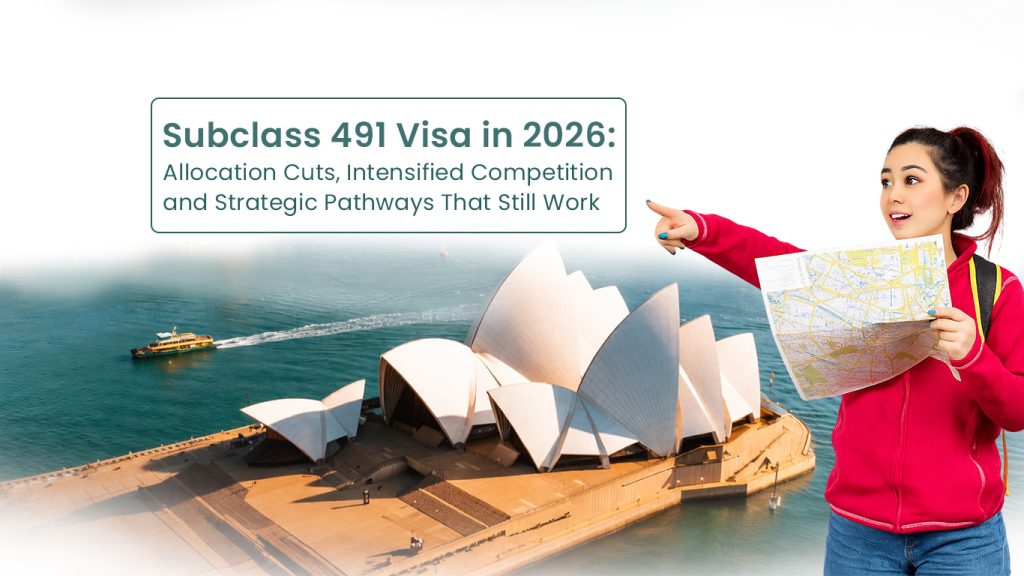
491 Visa Trend in 2026 – Australia’s regional migration landscape has entered a decisive phase in 2026—not because interest has diminished, but because opportunity has become more selective. The Skilled Work Regional (Provisional) visa (Subclass 491) remains among Australia’s most valuable immigration pathways for skilled professionals prepared to build careers outside metropolitan centers. However, the 2025–26 program year brings tightened allocations, heightened state selectivity, and intensified competition that demands strategic precision from applicants.
The fundamental shift is straightforward: demand continues rising while supply contracts, and states exercise increasingly targeted control over who receives nomination invitations.
The Critical Supply Constraint: Understanding 2026 Allocation Reductions
National 491 Nomination Allocation Comparison
The most significant development for 2026 isn’t policy language revision—it’s the substantial reduction in available nomination places:
| Program Year | 491 Nomination Places | Change |
|---|---|---|
| 2024–25 | 9,760 places | Baseline |
| 2025–26 | 7,500 places | -23% reduction |
This 2,260-place decrease represents a 23% contraction in regional provisional visa opportunities.
Total State Nomination Reductions (190 + 491 Combined)
The constraint extends across all state nomination categories:
| Program Year | Total State Nomination Places (190 + 491) | Change |
|---|---|---|
| 2024–25 | 26,260 places | Baseline |
| 2025–26 | 20,350 places | -22.5% reduction |
Competition has intensified not because applicant quality has declined, but because substantially fewer invitations exist to distribute.
2025–26 State and Territory Allocation Breakdown: Where the 491 Places Actually Exist
491 Visa Trend in 2026 – Regional migration operates as eight distinct state and territory nomination programs, each applying independent priorities, occupation preferences, and selection criteria.
491 Nomination Allocations by Jurisdiction (2025–26)
| State / Territory | 491 Places Allocated | Percentage of Total |
|---|---|---|
| Western Australia | 2,200 | 29.3% |
| New South Wales | 1,200 | 16.0% |
| South Australia | 800 | 10.7% |
| Northern Territory | 800 | 10.7% |
| Victoria | 700 | 9.3% |
| Queensland | 600 | 8.0% |
| Tasmania | 600 | 8.0% |
| Australian Capital Territory | 600 | 8.0% |
This distribution carries profound strategic implications: a competitive profile in one jurisdiction may prove entirely uncompetitive in another based on occupation demand, regional priorities, and allocation constraints.
Why State Nomination Targeting Has Intensified in 2026
Even when Australia’s overall Migration Program planning level appears numerically stable at 185,000 places, state nomination programs can experience dramatic competitiveness increases.
Factors Driving Heightened State Selectivity in 2026
1. Reduced Nomination Allocations Fewer places available means states must prioritize more aggressively among qualified applicants.
2. Priority Occupation Clustering States concentrate invitations within specific sectors experiencing acute workforce shortages:
- Healthcare professionals (nurses, allied health, medical practitioners)
- Care sector workers (aged care, disability support, childcare)
- Education professionals (teachers at all levels)
- Skilled trades (construction, automotive, electrical, plumbing)
- Infrastructure occupations (civil engineers, surveyors, project managers)
- Selected ICT specialists (software developers, cyber security, data analysts)
- Engineering disciplines (mechanical, electrical, civil)
3. Genuine Regional Contribution Emphasis States increasingly favor applicants demonstrating:
- Current residence in designated regional areas
- Existing regional employment in nominated occupation
- Clear, evidenced intention for long-term regional settlement
- Community ties and regional integration
4. Accelerated Pathway Closures States reach allocation limits progressively throughout the program year, closing pathways before 30 June when quotas fill.
Real-World Example: New South Wales publicly announced closures of specific 491 nomination streams during the current program year after exhausting allocated places—demonstrating this pattern is becoming standard practice, not an isolated occurrence.
What “Stronger State Targeting” Means for 2026 Applicants
1. Invitation Patterns Follow Occupation Clusters, Not Universal Distribution
States issue invitations aligned with immediate, specific workforce requirements. Even applicants with high points scores may not receive invitations if their occupation currently falls outside the state’s priority targeting mix.
2. Regional Employment and Residence Provide Decisive Advantages
State nomination programs heavily weight:
- Current regional residence – Living in designated regional areas
- Regional employment – Working in nominated occupation within the region
- Demonstrated commitment – Evidence supporting genuine intention to remain regionally settled
New South Wales explicitly describes the 491 visa as enabling skilled migrants to live, work, and study in designated regional areas for up to five years, with distinct pathways based on employment status, invitation category, or regional graduation credentials.
3. Mid-Year Pathway Closures Are Now Standard
Unlike previous years when pathways remained open until 30 June program year-end, 2026 sees states closing nomination streams mid-year once allocations fill. Applicants must maintain readiness to pivot strategies rapidly.
4. Evidence Quality Equals Points Competitiveness
States evaluate consistency and substantiation rigor, not merely claims:
- ANZSCO alignment – Employment duties precisely matching nominated occupation code
- Skills assessment correspondence – Work experience aligning exactly with assessment outcomes
- EOI accuracy – Expression of Interest free from inconsistencies or exaggerations
- Current documentation – Recent English test results, employment verification, partner assessments
5. Offshore Applications Remain Viable—With Sharper Strategic Targeting Required
Offshore applicants maintain eligibility across most state programs, but onshore indicators (regional employment, Australian qualifications, regional ties) often provide competitive advantages in selection rankings. Offshore strategies must demonstrate exceptional occupation demand alignment and evidence quality.
6. Regular Invitation Rounds Do Not Equal Relaxed Selection
States like South Australia publish monthly invitation outcomes and maintain consistent round schedules. However, invitation frequency does not reduce selectivity—states continue applying rigorous priority assessments regardless of round regularity.
How Many Points Do You Actually Need for 491 Success in 2026?
The minimum points test threshold of 65 points represents only the entry requirement, not competitive reality.
True Competitiveness Depends On:
- Occupation demand within your targeted state’s current priority mix
- EOI ranking relative to other applicants in your ANZSCO unit group
- Onshore profile strength including regional residence, employment, or study
- Evidence quality demonstrating genuine claims and ANZSCO alignment
- State-specific criteria beyond federal baseline requirements
Points Addition From State Nomination:
| Visa Subclass | State Nomination Points Boost |
|---|---|
| Subclass 491 | +15 points |
| Subclass 190 | +5 points |
Practical 2026 Strategic Mindset:
- Build robust base points first – Maximize age, English, qualifications, and experience points independently
- Treat nomination as enhancement – Don’t structure entire strategy around nomination points alone
- Diversify state and pathway options – Avoid single-jurisdiction dependency unless occupation shows consistent prioritization
491 vs 190 vs Regional Employer Sponsorship: Strategic Pathway Comparison 2026
| Factor | Subclass 491 | Subclass 190 | Regional Employer Sponsorship |
|---|---|---|---|
| Visa Type / Outcome | Provisional visa with PR pathway via 191 | Direct permanent residency from grant | Employer-sponsored regional visa, PR pathway varies by stream |
| Best Suited When | Subclass 190 too competitive in your occupation | You can compete effectively in high-demand state nomination | Genuine regional employment secured or realistically achievable |
| Primary Requirements | Regional compliance obligations, state nomination | Meet state criteria + secure nomination | Employer-driven process + comprehensive evidence documentation |
| Strategic Advantage | Most effective with clear state-specific strategy | Highly competitive in popular occupations/states | Excellent parallel pathway when nomination uncertain |
| Processing Complexity | Moderate – state application + visa lodgement | Moderate – state application + visa lodgement | High – employer nomination + extensive documentation |
| Ongoing Obligations | Must maintain regional residence, work, compliance | 2-year state residence commitment | Employer relationship maintenance, genuine employment |
From 491 to Permanent Residency: The Subclass 191 Pathway Explained
For most 491 applicants, the ultimate objective is permanent residency through Subclass 191 (Permanent Residence – Skilled Regional).
Critical Clarification From Department of Home Affairs:
There is no legislatively specified minimum income threshold for Subclass 191 eligibility.
Applicants must provide Australian Taxation Office (ATO) Notices of Assessment demonstrating taxable income across three income years within the eligible visa period.
Subclass 191 Permanent Residency Eligibility Based On:
- Genuine regional compliance – Meeting residence and work obligations in designated regional areas
- Documented taxable income history – ATO records showing consistent lawful employment
- Visa condition adherence – Maintaining all 491 visa conditions throughout the provisional period
- Three-year qualifying period – Holding 491 or eligible predecessor visa for minimum duration
Key Insight: PR eligibility centers on demonstrating genuine regional settlement and lawful income generation, not achieving a fixed salary benchmark.
2026 Invitation Round Timing: Why Strategic Monitoring Matters
State nomination functions as a program-year allocation race, not a single application event.
Critical Monitoring Points for 2026 Applicants:
Pathway Closure Tracking
- Monitor when specific states announce allocation exhaustion
- Track occupation-specific closures within state programs
- Identify states approaching capacity limits
Invitation Round Reporting
- Review monthly or periodic invitation outcome publications
- Analyze occupation representation in recent invitation rounds
- Assess points score trends within your occupation
Occupation Priority Fluctuations
- Track shifting state priorities based on labor market changes
- Monitor occupation list updates and modifications
- Identify emerging high-demand occupations
Response Window Management
- Prepare documentation in advance for rapid submission
- Understand state-specific response timeframes post-invitation
- Maintain current skills assessments, English tests, and documentation
Strategic Success Framework for 491 Applications in 2026
Phase 1: Occupation and State Alignment Research
Action Steps:
- Cross-reference your occupation against each state’s priority occupation lists
- Identify which jurisdictions consistently invite your occupation
- Review state-specific requirements beyond federal baseline
- Assess allocation sizes relative to likely applicant volumes
Phase 2: Points Optimization
Maximum Points Categories:
- Age: Ensure application within optimal age brackets (25-32 years = 30 points maximum)
- English: Achieve superior or proficient scores (PTE 79+ each, IELTS 8+ each = 20 points)
- Qualifications: Consider additional Australian study if strategic (5-15 points)
- Experience: Document all skilled employment meeting ANZSCO requirements (5-20 points)
- Partner Skills: Coordinate partner assessments and English tests (5-10 points)
Phase 3: Regional Connection Building (For Onshore Applicants)
Strategic Actions:
- Secure regional employment in nominated occupation
- Establish regional residence in target state
- Complete regional qualifications where beneficial
- Build community ties and integration evidence
Phase 4: Evidence Quality Assurance
Documentation Excellence:
- Employment references precisely matching ANZSCO descriptors
- Payslips, tax documents, organizational charts confirming role
- Skills assessment recent and occupation-aligned
- English test results current (within validity period)
- Partner documentation comprehensive if claiming points
Phase 5: Multi-State Strategy Development
Diversification Approach:
- Submit EOIs to multiple compatible states
- Monitor invitation patterns across all eligible jurisdictions
- Maintain flexibility to accept invitations from any viable state
- Prepare state-specific application materials in advance
Common 491 Strategy Mistakes to Avoid in 2026
Mistake 1: Assuming High Points Guarantee Invitation
Reality: Occupation demand within specific states matters more than points alone. A 95-point applicant in an unprioritized occupation may wait longer than a 75-point applicant in a critical shortage occupation.
Mistake 2: Applying Only to Largest Allocation States
Reality: Western Australia’s 2,200-place allocation attracts proportionally massive applicant volumes. Smaller allocation states may offer better competitiveness in specific occupations.
Mistake 3: Waiting for “Perfect” Points Before Applying
Reality: Pathways close mid-year when allocations fill. Delaying applications to optimize points may result in pathway closure before reaching target score.
Mistake 4: Neglecting State-Specific Requirements
Reality: Federal eligibility alone is insufficient. Each state applies unique criteria, occupation lists, work experience rules, and priority settings requiring separate compliance.
Mistake 5: Over-Relying on Nomination Points
Reality: State nomination provides 15 points, but building competitive base points (75-80+) independently creates stronger overall positioning.
Mistake 6: Ignoring Regional Employment Opportunities
Reality: Securing genuine regional employment in nominated occupation dramatically strengthens applications and demonstrates commitment states prioritize.
Frequently Asked Questions (FAQs)
Q1. Are there genuinely fewer 491 nomination places available in 2026?
Yes. The 2025–26 Migration Program reduced Skilled Work Regional (Subclass 491) allocations to 7,500 places, down from 9,760 places in 2024–25. This 23% reduction means significantly heightened competition and more selective state nomination criteria, despite sustained or increased applicant demand.
Q2. Which state or territory received the highest 491 allocation for 2025–26?
Western Australia holds the largest 491 allocation with 2,200 places. However, higher allocation does not automatically translate to easier nomination success, as WA maintains strict occupation prioritization, sector targeting, and applicant profile requirements aligned with state-specific workforce needs.
Q3. How long does the Subclass 491 visa remain valid?
The Subclass 491 visa grants up to five years of provisional residence. Throughout this period, visa holders must live, work, and study exclusively in designated regional areas while meeting all state nomination and visa conditions to maintain eligibility for subsequent permanent residency pathways.
Q4. How many additional points does 491 state nomination provide?
State or family nomination for the Subclass 491 visa adds 15 points to your points test score. This substantial boost frequently makes the difference for applicants who otherwise lack competitiveness for Subclass 189 (Skilled Independent) or Subclass 190 (Skilled Nominated) invitations.
Q5. Is the 491 pathway easier to secure than 190 in 2026?
Sometimes, but not universally. The 491 can offer more accessibility in jurisdictions and occupations experiencing acute regional shortages. However, in popular occupations or competitive states, 491 nomination can prove equally or more competitive than Subclass 190 pathways.
Q6. Can state nomination pathways close before the 30 June 2026 program year-end?
Yes, absolutely. States close nomination streams once annual allocations reach capacity, often well before 30 June. New South Wales has already closed specific nomination pathways after exhausting allocated places, demonstrating that delayed applications risk pathway closure eliminating otherwise viable options.
Q7. Do all states and territories apply identical nomination criteria?
No. Each jurisdiction operates independent nomination programs with unique occupation lists, minimum points thresholds, work experience requirements, regional definitions, and priority occupation settings. Meeting Department of Home Affairs federal requirements alone is insufficient—state-specific strategic compliance is critical.
Q8. Does the Subclass 491 still provide a pathway to permanent residency?
Yes. The 491 maintains a clear, established pathway to permanent residency, typically through Subclass 191 (Permanent Residence – Skilled Regional). Applicants must satisfy residence obligations, work requirements, and income documentation standards throughout their regional provisional period to transition successfully.
Q9. Is there a minimum salary threshold required for Subclass 191 permanent residency?
No fixed minimum salary exists for Subclass 191 eligibility. However, applicants must provide Australian Taxation Office Notices of Assessment demonstrating taxable income across the required three-year period, making consistent, lawful employment throughout the 491 period essential for PR transition.
Q10. Do states conduct invitation rounds on regular schedules?
Some states publish frequent updates and maintain consistent monthly or periodic invitation rounds, but invitation frequency does not reduce selection stringency. States continue prioritizing high-quality profiles precisely aligned with immediate labor market needs, regardless of how often invitation rounds occur.
Q11. Can offshore applicants still compete successfully for 491 nomination in 2026?
Yes, offshore applications remain viable, but onshore applicants often demonstrate competitive advantages through regional employment, Australian qualifications, or established regional connections. Offshore strategies require exceptional occupation demand alignment, superior evidence quality, and targeting states with explicit offshore nomination streams.
Q12. What happens if my occupation is not on a state’s priority list?
If your occupation doesn’t appear on a state’s current priority list, nomination prospects diminish significantly regardless of points score. Consider alternative states where your occupation maintains priority status, explore employer sponsorship pathways, or consider strategic course completion in higher-demand occupations.
Q13. How quickly should I respond after receiving a state nomination invitation?
Response timeframes vary by state, typically ranging from 14 to 28 days. Prepare all required documentation in advance to enable rapid, complete submission. Missing response deadlines results in invitation expiry and forfeited nomination opportunity.
Q14. Can I change states after receiving 491 nomination?
No. Subclass 491 nomination is state-specific with binding regional residence obligations. Visa holders must live and work in the nominating state’s designated regional areas throughout the visa period. Relocating to different states or metropolitan areas constitutes visa condition breaches.
Q15. Should I apply to multiple states simultaneously?
Yes, where eligible. Submitting Expressions of Interest to all compatible states maximizes invitation opportunities. However, ensure you meet each state’s specific requirements and genuinely intend regional settlement in any jurisdiction from which you accept nomination.
Final Assessment: The 2026 Regional Migration Reality
The Subclass 491 visa in 2026 is most accurately characterized as high demand, constrained supply, and intensified state selectivity.
It remains a powerful, viable pathway to Australian permanent residency—but exclusively for applicants whose strategies align precisely with current state priorities, occupation demand patterns, and evidence quality expectations, rather than approaches that succeeded in previous program years.
Success in 2026 requires:
- Strategic occupation and state alignment research
- Points optimization across all available categories
- Superior evidence quality and ANZSCO compliance
- Regional connection building where feasible
- Multi-state EOI diversification
- Continuous monitoring of pathway availability
- Rapid response capability when invitations issue
With allocation constraints tightening and state targeting sharpening, professional migration guidance helps skilled applicants navigate 2026’s competitive regional nomination landscape effectively.
Read Next –
6 Best Visas to Live and Work in Australia If You Are Over 45 – The Complete 2026 Guide