Disclaimer: The information provided in this article is for general informational purposes only and is based on publicly available information at the time of publication. Australian government application fees, immigration policies, eligibility requirements, and processing procedures are subject to change by the Department of Home Affairs without prior notice. While every effort has been made to ensure the accuracy of the information, Shri Krishna Consultants does not guarantee that all details are complete, current, or applicable to every individual circumstance. Applicants should always refer to the official website for the latest updates or seek professional migration advice before lodging a visa application. This article does not constitute legal or migration advice and should not be relied upon as a substitute for professional consultation.
Australia Visa Application Fees Increase from 1 July 2026
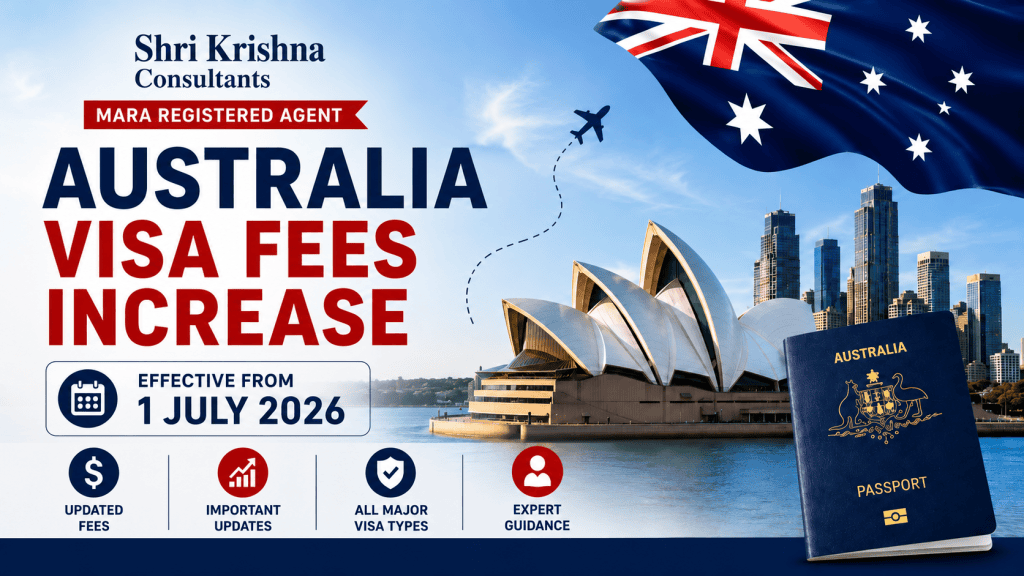
If you’re planning to study, work, visit, or migrate to Australia, understanding the latest government application costs is an important part of your preparation. From 1 July 2026, the Department of Home Affairs (DHA) introduced revised Visa Application Charges (VACs) for several temporary and permanent visa categories.
The updated fee schedule affects thousands of applicants worldwide, including international students, skilled workers, employer-sponsored employees, tourists, business investors, graduates, and families. These annual revisions help ensure Australia’s migration program continues to operate efficiently while reflecting changes in administrative costs and economic conditions.
Whether you intend to lodge a Student Visa, Visitor Visa, Skilled Migration Visa, Temporary Graduate Visa, or Partner Visa application, knowing the current government charges can help you plan your finances and avoid unexpected expenses..
Fees 2026 – DHA Latest Government Charges
Every financial year, the Government reviews a range of government charges associated with immigration and visa services. From 1 July 2026, revised (VACs) officially came into effect for many temporary and permanent visa categories administered by the Department.
These updated charges apply to applications lodged on or after 1 July 2026. Applicants who submitted their visa applications before this date are generally assessed under the previous fee schedule, while new applications lodged from 1 July 2026 are subject to the revised government charges.
Key Updates
- Visitor visas
- Student visas
- Temporary graduate visas
- Employer-sponsored visas
- Skilled migration visas
- Family and partner visas
- Other selected visa subclasses
It is important to understand that Charges are government fees payable directly to the Department of Home Affairs when lodging a visa application. These charges are separate from any professional service fees charged by migration agents, education consultants, or legal representatives.
Since visa charges may change periodically, applicants should always confirm the latest fees before preparing their application budget. Being aware of the updated charges helps applicants avoid delays and ensures sufficient financial planning throughout the visa application process.
Understanding application charges Home Affairs
Fees 2026 for Student Visa (Subclass 500)
The Visa Application Charge (VAC) is the official government fee paid to the Department of Home Affairs when submitting a visa application. Every visa category has its own application charge, which varies depending on the type of visa being applied for and the purpose of travel.
The Visa Application Charge forms an essential part of every visa application and is generally payable at the time of lodging the application online through the Department of Home Affairs’ official Immi Account system.
Applicants should note that the government visa application charge is different from other expenses that may arise during the visa process. For example, depending on the visa category, applicants may also need to budget for English language tests, health examinations, police clearance certificates, skills assessments, Overseas Student Health Cover ,document translation, and biometric collection where required.
Another important point to remember is that the published government fee generally represents the charge for the primary applicant. If family members such as a spouse, partner, or dependent children are included in the application, additional government charges may apply according to the relevant visa subclass.
government fees are established by the Government and may be reviewed annually. Applicants should therefore rely only on official government information or seek advice from qualified migration professionals when calculating the total cost of their visa application.
Fees Effective from 1 July 2026
Additional Charges for Family Members
The following table outlines the updated fee for several of most commonly applied visa categories. These charges apply to the primary applicant and are effective from 1 July 2026.
| Visa Category | Visa Subclass | Government Fee (AUD) |
| Visitor Visa | 600 | $250 |
| Student Visa | 500 | $2,500 |
| Temporary Graduate Visa | 485 | $5,750 |
| Skills in Demand Visa | 482 | $4,015 |
| Skilled Independent Visa | 189 | $6,135 |
| Skilled Nominated Visa | 190 | $6,140 |
| Skilled Work Regional (Provisional) Visa | 491 | $6,140 |
| Partner Visa | 820/801 & 309/100 | $11,710 |
Important Note: The fees listed above are the government charges for the primary applicant only. Additional charges may apply for secondary applicants, dependent children, and other accompanying family members based on the visa subclass and individual circumstances.
Applicants are encouraged to verify the latest fees before lodging their application, as government charges are subject to change in accordance with immigration regulations.
Immigration System Continues to Support Global Talent
Australia’s immigration system is the most structured and transparent migration systems in the world. It offers numerous visa pathways designed to meet the needs of international students, skilled professionals, employers, tourists, business investors, researchers, and families wishing to reunite with loved ones.
Each visa category serves a specific purpose and includes eligibility criteria relating to education, employment, financial capacity, English language proficiency, health requirements, and character assessments. Applicants are expected to satisfy these requirements before a visa can be granted.
International students continue to choose this country because of its globally recognised universities, practical learning environment, and access to post-study work opportunities. Skilled professionals benefit from the nation demand for qualified workers across industries such as healthcare, engineering, information technology, education, construction, hospitality, and accounting.
Employer-sponsored visa programs allow businesses to address genuine labour shortages by recruiting suitably qualified overseas workers where local talent is unavailable. At the same time, skilled migration program continues to attract highly qualified individuals who contribute to the country’s long-term economic development.
Family migration also remains an important component of immigration program, enabling eligible partners, parents, children, and other family members to reunite with citizens and permanent residents under specific visa categories.
Migration system’s balanced migration framework helps maintain economic growth while ensuring that visa applicants meet clearly defined legislative and policy requirements before entering the country.
Major Updated visa costs from 1 July 2026
Alongside the revised government application fees (VACs), the Government has introduced several important immigration updates effective from 1 July 2026. These changes reflect ongoing commitment to maintaining a fair, efficient, and sustainable migration program while responding to evolving labour market needs and economic conditions.
Whether you are an international student, skilled worker, employer, or visitor, understanding these changes can help you plan your visa application more effectively.
The key updates introduced from 1 July 2026 include:
- Revised Application Charges across multiple visa subclasses.
- Increased income thresholds for employer-sponsored visa programs.
- Updated application charges for Working Holiday visas.
- Annual indexation of selected migration-related fees and charges.
- Continued improvements to digital visa application system.
Applicants are encouraged to review these updates carefully before lodging their visa applications, as the revised requirements and fees apply to applications submitted on or after 1 July 2026.
Revised Income Thresholds for Employer-Sponsored Visas
One of the most significant immigration changes introduced from 1 July 2026 is the increase in minimum salary requirements for employer-sponsored visas.
Australia regularly reviews these salary thresholds to ensure overseas workers receive wages that are consistent with current labour market conditions and workplace standards.
From 1 July 2026, the following indexed income thresholds apply:
| Income Threshold | New Amount (AUD) |
| Core Skills Income Threshold (CSIT) | $77,691 |
| Specialist Skills Income Threshold (SSIT) | $141,210 |
| Temporary Skilled Migration Income Threshold (TSMIT) | $77,691 |
These revised thresholds apply to new employer nominations lodged from 1 July 2026 and are designed to ensure sponsored workers are paid fairly while supporting skilled workforce needs.
It is important to note that these updated salary thresholds generally do not affect visa holders whose nominations were approved before the implementation date. However, new applicants and sponsoring employers should ensure that employment contracts meet the applicable income requirements before lodging an application.
Working Holiday Visa Updates
Working Holiday Maker (WHM) program continues to provide young travellers with the opportunity to experience life in Australia while supporting themselves through short-term employment.
From 1 July 2026, the Government has also updated the government application charge for Working Holiday visas.
The revised application fee is:
| Visa | Subclass | Government Fee (AUD) |
| Working Holiday Visa | 417 | $680 |
| Work and Holiday Visa | 462 | $680 |
The Working Holiday program remains popular among eligible applicants from participating countries, allowing them to travel, work, and experience diverse culture and lifestyle.
Eligibility requirements continue to vary depending on nationality, age limits, passport eligibility, and bilateral agreements between Australia and participating countries.
Applicants should carefully review the latest eligibility requirements before lodging their application.
Digital Visa Application Process Continues to Expand
Australia remains one of the world’s leading countries in providing a fully digital immigration system.
Most visa applications are now submitted electronically through the department’ Immi Account platform, allowing applicants to complete the entire application process online.
The online system enables applicants to:
- Lodge visa applications securely.
- Upload supporting documents.
- Track application progress.
- Receive official correspondence.
- Update personal information.
- Make online payments.
- Respond to requests for additional documents.
This streamlined digital approach has significantly improved processing efficiency and enhanced communication between applicants and the Department of Home Affairs.
Applicants are encouraged to prepare all required documents before starting their online application to minimise delays during assessment.
Migration Program Continues to Support Economic Growth
Migration program plays a vital role in supporting the country’s economy, workforce development, and population growth.
Every year, Australia welcomes thousands of skilled professionals, international students, entrepreneurs, investors, and family migrants who contribute to the nation’s social and economic development.
The migration program focuses on attracting individuals who possess the education, qualifications, skills, and experience needed across a range of industries.
Some of Australia’s highest-demand sectors include:
- Healthcare and Nursing
- Information Technology
- Engineering
- Construction
- Education
- Accounting
- Hospitality
- Agriculture
- Mining
- Aged Care
- Cyber Security
- Renewable Energy
By aligning migration policies with labour market demands, continues to address workforce shortages while strengthening long-term economic resilience.
One of the World’s Most Attractive Study Destinations
This country continues to attract hundreds of thousands of international students every year due to its globally recognized education system and student-friendly environment.
Universities, colleges, and vocational institutions offer qualifications that are respected worldwide, giving graduates a competitive advantage in the global employment market.
Students benefit from:
- Internationally recognized qualifications.
- Industry-focused learning.
- Modern teaching facilities.
- Practical training opportunities.
- Diverse course options.
- Research excellence.
- Multicultural campuses.
- High-quality student support services.
- Opportunities to gain valuable work experience during studies.
Graduates may also be eligible for post-study work opportunities, allowing them to gain professional experience in Australia after completing eligible qualifications.
Australia’s education sector continues to play a major role in developing future global talent.
Excellent Career Opportunities for Skilled Professionals
Australia’s stable economy continues to generate strong demand for skilled workers across numerous industries.
Professionals with recognised qualifications and relevant work experience may have opportunities to pursue employment through employer-sponsored programs or skilled migration pathways.
Many occupations continue to appear on skilled occupation lists, creating opportunities for eligible overseas professionals to contribute their expertise to the workforce.
Australia is leading internationally for:
- Competitive salaries.
- Safe workplaces.
- Strong employee protections.
- Professional development opportunities.
- Modern infrastructure.
- High living standards.
- Inclusive workplaces.
- Work-life balance.
These factors continue to make an attractive destination for skilled migrants seeking long-term career growth.
Things to Check Before Applying
Before submitting any application, applicants should ensure they are fully prepared and meet all applicable eligibility requirements.
Some important steps include:
Confirm Your Eligibility
Each visa subclass has specific eligibility requirements relating to age, qualifications, English language proficiency, financial capacity, work experience, sponsorship, or relationship status.
Applicants should carefully review the requirements applicable to their chosen category before lodging an application.
Prepare Complete Supporting Documents
Providing complete and accurate documentation is one of the most important aspects of a successful application.
Depending on the subclass, supporting documents may include:
- Passport
- Educational qualifications
- Employment documents
- English language test results
- Financial evidence
- Health examinations
- Police clearance certificates
- Relationship evidence
- Skills assessment reports
Submitting incomplete information may result in delays or requests for additional documents.
Check Passport Validity
Applicants should ensure that their passport remains valid for the required period before submitting their application.
If a passport is due to expire shortly, renewing it before lodging the application may help avoid unnecessary complications.
Understand Government Charges
Applicants should familiarise themselves with the applicable government Application Charge before beginning the application process.
Seek Professional Guidance if Required
Australian immigration laws and visa requirements can be complex.
Applicants who are unsure about eligibility, documentation requirements, or the appropriate pathway may benefit from obtaining professional guidance before lodging their application.
Professional advice can help applicants prepare accurate documentation and better understand the visa process.
Why Staying Updated with Immigration Changes Is Important
Australian immigration policies are reviewed regularly to ensure they continue to meet the country’s economic, social, and workforce priorities.
Changes may include updates to:
- application charges.
- Occupation lists.
- English language requirements.
- Salary thresholds.
- Health requirements.
- Processing arrangements.
- Legislative amendments.
For this reason, applicants should always rely on the most recent information available when planning their journey.
Being aware of current immigration requirements helps applicants make informed decisions and reduces the likelihood of delays caused by outdated information.
Frequently Asked Questions (FAQs)
1. When did the new Australian visa application fees come into effect?
The revised Australian Visa Application Charges became effective on 1 July 2026. These updated government fees apply to applications lodged on or after this date.
2. Who introduced these new visa application charges?
The updated visa application charges were introduced by the Australian Government through the Department of Home Affairs (DHA) as part of its annual review of fees and immigration-related charges.
3. Do the new fees apply to applications submitted before 1 July 2026?
Generally, no. Applications lodged before 1 -07-2026 are assessed using the government charges that were applicable on the date the application was submitted.
4. What is the new Subclass 500 application fee?
From 1 July 2026, the Subclass 500 application charge for the primary applicant is AUD $2,500.
5. What is the new Visitor Visa (Subclass 600) application fee?
The Subclass 600 application fee is AUD $250 for the primary applicant.
6. How much is the Temporary Graduate Visa (Subclass 485) application charge?
The updated government application charge for the Temporary Graduate Visa (Subclass 485) is AUD $5,750.
7. What is the Skills in Demand Visa (Subclass 482) application fee?
Applicants applying for the Skills in Demand (Subclass 482) are required to pay a government application charge of AUD $4,015.
8. What are the updated Skilled Migration Processing Charges?
The current government application charges are:
- Skilled Independent (Subclass 189): AUD $6,135
- Skilled Nominated (Subclass 190): AUD $6,140
- Skilled Work Regional (Subclass 491): AUD $6,140
9. What is the new Partner Visa application fee?
The government application charge for Partner Visas (Subclass 820/801 and 309/100) is AUD $11,710.
10. Are these fees applicable only to the primary applicant?
Yes. The published Immigration Fees generally refer to the primary applicant. Additional government charges usually apply for spouses, partners, and dependent children included in the application.
11. Are Australian application fees refundable?
In most situations, Cost of Applying for a Visa are non-refundable, even if the application is refused or withdrawn. Applicants should carefully review all eligibility requirements before lodging an application.
12. Are migration agent fees included in the government visa charges?
No. Government Official Visa Fees are separate from professional fees charged by migration agents, education consultants, or legal representatives.
13. What other expenses should applicants consider?
Depending on the visa category, applicants may also need to budget for:
- English language test fees
- Medical examinations
- Police clearance certificates
- Skills assessments
- Overseas Student Health Cover (OSHC)
- Document translation
- Biometric collection (where required)
14. Have employer-sponsored visa requirements changed?
Yes. From 1 July 2026, Australia introduced revised income thresholds for employer-sponsored visa nominations to reflect current labour market conditions.
15. Have Working Holiday Visa fees changed?
Yes. The application charge for both the Working Holiday Visa (Subclass 417) and Work and Holiday Visa (Subclass 462) has been updated to AUD $680.
16. Where can applicants check the latest Australian visa charges?
Applicants should always refer to the official Department of Home Affairs website or consult a qualified migration professional for the latest government charges and immigration updates.
17. Can Australian visa fees change every year?
Yes. The Australian Government reviews many Visa Expenses annually, and updated fees generally become effective from 1 July each year.
18. Does paying the visa application fee guarantee visa approval?
No. Payment of the Visa Application Charge allows the to assess the application, but visa approval depends on whether the applicant satisfies all legislative and policy requirements.
19. Why is it important to stay updated with immigration changes?
Australian immigration policies, government charges, and visa requirements are regularly reviewed. Staying informed helps applicants prepare accurate applications and avoid unexpected delays or additional costs.
20. Can Shri Krishna Consultants assist with Australian visa applications?
Yes. Shri Krishna Consultants provides professional guidance for Australian education and migration pathways, including university admissions, documentation assistance, visa application support, and immigration advice tailored to each applicant’s circumstances.
Conclusion
The Australian Government’s revised Service Fees, effective from 1 July 2026, represent an important update for anyone planning to visit, study, work, or migrate to Australia. As visa application fees form a significant part of the overall immigration process, understanding the latest government charges allows applicants to plan their finances more effectively and avoid unexpected costs during the application journey.
In addition to updated Processing Fees, Australia has also introduced revised employer-sponsored income thresholds and changes affecting Working Holiday visa applicants. These updates reflect the Government’s ongoing efforts to maintain a modern, sustainable, and responsive migration system while supporting Australia’s economic growth and workforce requirements.
Whether you are applying for a Visitor , Student , Temporary Graduate , Skilled Migration , Employer-Sponsored , or Partner , it is essential to ensure that you meet the relevant eligibility criteria, prepare complete supporting documentation, and verify the latest government requirements before lodging your application.
As Australian immigration policies continue to evolve, staying informed about legislative changes, Entry permit requirements, and government charges can significantly improve your application experience. Careful planning, accurate documentation, and professional guidance can help applicants navigate the visa process with greater confidence.
If you are considering Australia as your destination for education, employment, family reunification, or permanent migration, understanding the latest updates introduced from 1 July 2026 is an important first step toward achieving your goals.
Need Professional Assistance with Your Australian Immigration permit?
At Shri Krishna Education & Migration Consultants, we are committed to helping students, skilled professionals, and families navigate the Australian immigration process with confidence.
Our experienced team provides comprehensive support, including:
- Student Admission Guidance
- Course & University Selection
- Genuine Student (GS) Statement Assistance
- Documentation Support
- Skilled Migration Guidance
- Employer-Sponsored Visa Assistance
- Partner & Family Visa Support
- Visitor Visa Applications
- Post-Study Visa Guidance
- Professional Immigration Consultation
Whether you’re planning to study, work, visit, or settle in Australia, we’re here to support you at every stage of your journey.Australia continues to be one of the world’s most preferred destinations for international students, skilled professionals, business investors, tourists, and families seeking new opportunities. Known for its high-quality education system, strong economy, multicultural society, and excellent quality of life, Australia attracts thousands of applicants every year from across the globe.
To ensure that Australia’s migration and system remains efficient and sustainable, the Australian Government reviews various immigration policies and government charges annually. As part of this annual review, the Department has implemented revised Official Fees (VACs) effective 1 July 2026. These updated fees apply to a wide range of categories, including visitor visas, student visas, skilled migration visas, employer-sponsored visas, temporary graduate visas, and partner visas.
Whether you are planning to study, work, visit, or permanently migrate to Australia, understanding the latest Entry Fees is an essential part of your planning process. Government fees represent one of the primary costs associated with lodging a application, and applicants should always ensure they are referring to the most up-to-date fee schedule before submitting their application.
Apart from the revised Fee Structure the Australian Government has also introduced several other immigration-related updates from 1 July 2026, including revised income thresholds for employer-sponsored visas and changes affecting Working Holiday applicants. These updates are intended to reflect current economic conditions, labour market requirements, and administrative costs while supporting Australia’s long-term migration objectives.
This comprehensive guide explains the latest the nation application charges effective from 1 July 2026, provides an overview of Australia’s system, highlights key immigration updates, and answers common questions to help applicants prepare for a successful application.
New Government Charges Effective from 1 July 2026
Every financial year, the nation Government reviews a range of government charges associated with immigration and services. From 1 July 2026, revised Current Charges (VACs) officially came into effect for many temporary and permanent categories.
These updated charges apply to applications lodged on or after 1 July 2026. Applicants who submitted their applications before this date are generally assessed under the previous fee schedule, while new applications lodged from 1 July 2026 are subject to the revised government charges.
The updated fees apply across numerous streams, including:
- Visitor visas
- Student visas
- Temporary graduate visas
- Employer-sponsored visas
- Skilled migration visas
- Family and partner visas
- Other selected subclasses
These charges are separate from any professional service fees charged by migration agents, education consultants, or legal representatives.
Since visa charges may change periodically, applicants should always confirm the latest fees before preparing their application budget. Being aware of the updated charges helps applicants avoid delays and ensures sufficient financial planning throughout the visa application process.
What is a Travel document Application Charge?
The Application Charge (VAC) is the official government fee paid to the Emabssy when submitting a application. Every category has its own application charge, which varies depending on the type of being applied for and the purpose of travel.
The Application Charge forms an essential part of every application and is generally payable at the time of lodging the application online through the official Account system.
Applicants should note that the government application charge is different from other expenses that may arise during the process. For example, depending on the visa category, applicants may also need to budget for English language tests, health examinations, police clearance certificates, skills assessments, Overseas Student Health Cover (OSHC), document translation, and biometric collection where required.
Another important point to remember is that the published government fee generally represents the charge for the primary applicant. If family members such as a spouse, partner, or dependent children are included in the application, additional government charges may apply according to the relevant subclass.
Applicants should therefore rely only on official government information or seek advice from qualified migration professionals when calculating the total cost of their application.
Visa Application Fees Effective from 1 July 2026
The following table outlines the updated Official Application Costs (VACs) for several of Australia’s most commonly applied visa categories. These charges apply to the primary applicant and are effective from 1 July 2026.
| Visa Category | Visa Subclass | Government Fee (AUD) |
| Visitor Visa | 600 | $250 |
| Student Visa | 500 | $2,500 |
| Temporary Graduate Visa | 485 | $5,750 |
| Skills in Demand Visa | 482 | $4,015 |
| Skilled Independent Visa | 189 | $6,135 |
| Skilled Nominated Visa | 190 | $6,140 |
| Skilled Work Regional (Provisional) Visa | 491 | $6,140 |
| Partner Visa | 820/801 & 309/100 | $11,710 |
Important Note: The fees listed above are the government charges for the primary applicant only. Additional charges may apply for secondary applicants, dependent children, and other accompanying family members based on the subclass and individual circumstances.
Applicants are encouraged to verify the latest fees before lodging their application, as government charges are subject to change in accordance with Australian immigration regulations.
Skilled Migration Opportunities in Australia
Australia’s immigration system is the most structured and transparent migration systems in the world. It offers numerous pathways designed to meet the needs of international students, skilled professionals, employers, tourists, business investors, researchers, and families wishing to reunite with loved ones.
International students continue to choose Australia because of its globally recognized universities, practical learning environment, and access to post-study work opportunities. Skilled professionals benefit from Australia’s demand for qualified workers across industries such as healthcare, engineering, information technology, education, construction, hospitality, and accounting.
Australia’s balanced migration framework helps maintain economic growth while ensuring that applicants meet clearly defined legislative and policy requirements before entering the country.
Key Immigration Updates for Applicants
Alongside the revised Charges , the Australian Government has introduced several important immigration updates effective from 1 July 2026. These changes reflect Australia’s ongoing commitment to maintaining a fair, efficient, and sustainable migration program while responding to evolving labour market needs and economic conditions.
Whether you are an international student, skilled worker, employer, or visitor, understanding these changes can help you plan your Australian application more effectively.
The key updates introduced from 1 July 2026 include:
- Revised Embassy fee across multiple subclasses.
- Increased income thresholds for employer-sponsored visa programs.
- Updated application charges for Working Holiday visas.
- Annual indexation of selected migration-related fees and charges.
- Continued improvements to Australia’s digital visa application system.
Applicants are encouraged to review these updates carefully before lodging their applications, as the revised requirements and fees apply to applications submitted on or after 1 July 2026.
Revised Income Thresholds for Employer-Sponsored Visas
One of the most significant immigration changes introduced from 1 July 2026 is the increase in minimum salary requirements for employer-sponsored visas.
Australia regularly reviews these salary thresholds to ensure overseas workers receive wages that are consistent with current labour market conditions and Australian workplace standards.
From 1 July 2026, the following indexed income thresholds apply:
| Income Threshold | New Amount (AUD) |
| Core Skills Income Threshold (CSIT) | $77,691 |
| Specialist Skills Income Threshold (SSIT) | $141,210 |
| Temporary Skilled Migration Income Threshold (TSMIT) | $77,691 |
These revised thresholds apply to new employer nominations lodged from 1 July 2026 and are designed to ensure sponsored workers are paid fairly while supporting Australia’s skilled workforce needs.
It is important to note that these updated salary thresholds generally do not affect holders whose nominations were approved before the implementation date. However, new applicants and sponsoring employers should ensure that employment contracts meet the applicable income requirements before lodging an application.
Working Holiday Visa Updates
Australia’s Working Holiday Maker program continues to provide young travelers with the opportunity to experience life in Australia while supporting themselves through short-term employment.
From 1 July 2026, the Australian Government has also updated the government application charge for Working Holiday visas.
The revised application fee is:
| Visa | Subclass | Government Fee (AUD) |
| Working Holiday Visa | 417 | $680 |
| Work and Holiday Visa | 462 | $680 |
The Working Holiday program remains popular among eligible applicants from participating countries, allowing them to travel, work, and experience Australia’s diverse culture and lifestyle.
Eligibility requirements continue to vary depending on nationality, age limits, passport eligibility, and bilateral agreements between Australia and participating countries.
Applicants should carefully review the latest eligibility requirements before lodging their application.
Australia’s Digital Visa Application Process Continues to Expand
Australia remains one of the world’s leading countries in providing a fully digital immigration system.
Most Travel document applications are now submitted electronically through the Immi Account platform, allowing applicants to complete the entire application process online.
The online system enables applicants to:
- Lodge Visa request securely.
- Upload supporting documents.
- Track application progress.
- Receive official correspondence.
- Update personal information.
- Make online payments.
- Respond to requests for additional documents.
This streamlined digital approach has significantly improved processing efficiency and enhanced communication between applicants and the Embassy.
Applicants are encouraged to prepare all required documents before starting their online application to minimise delays during assessment.
Australia’s Migration Program Continues to Support Economic Growth
Australia’s migration program plays a vital role in supporting the country’s economy, workforce development, and population growth.
Every year, Australia welcomes thousands of skilled professionals, international students, entrepreneurs, investors, and family migrants who contribute to the nation’s social and economic development.
The migration program focuses on attracting individuals who possess the education, qualifications, skills, and experience needed across a range of industries.
Some of Australia’s highest-demand sectors include:
- Healthcare and Nursing
- Information Technology
- Engineering
- Construction
- Education
- Accounting
- Hospitality
- Agriculture
- Mining
- Aged Care
- Cyber Security
- Renewable Energy
By aligning migration policies with labour market demands, Australia continues to address workforce shortages while strengthening long-term economic resilience.
One of the World’s Most Attractive Study Destinations
Australia continues to attract hundreds of thousands of international students every year due to its globally education system and student-friendly environment.
Australian universities, colleges, and vocational institutions offer qualifications that are respected worldwide, giving graduates a competitive advantage in the global employment market.
Students benefit from:
- Internationally globally qualifications.
- Industry-focused learning.
- Modern teaching facilities.
- Practical training opportunities.
- Diverse course options.
- Research excellence.
- Multicultural campuses.
- High-quality student support services.
- Opportunities to gain valuable work experience during studies.
Graduates may also be eligible for post-study work opportunities, allowing them to gain professional experience in Australia after completing eligible qualifications.
Australia’s education sector continues to play a major role in developing future global talent.
Australia Offers Excellent Career Opportunities for Skilled Professionals
Australia’s stable economy continues to generate strong demand for skilled workers across numerous industries.
Professionals with recognized qualifications and relevant work experience may have opportunities to pursue employment through employer-sponsored programs or skilled migration pathways.
Many occupations continue to appear on Australia’s skilled occupation lists, creating opportunities for eligible overseas professionals to contribute their expertise to the Australian workforce.
Australia is recognized internationally for:
- Competitive salaries.
- Safe workplaces.
- Strong employee protections.
- Professional development opportunities.
- Modern infrastructure.
- High living standards.
- Inclusive workplaces.
- Work-life balance.
These factors continue to make Australia an attractive destination for skilled migrants seeking long-term career growth.
Important Information Before Lodging Your Australian Visa Application
Before submitting any Australian application, applicants should ensure they are fully prepared and meet all applicable eligibility requirements.
Some important steps include:
Confirm Your Eligibility
Each subclass has specific eligibility requirements relating to age, qualifications, English language proficiency, financial capacity, work experience, sponsorship, or relationship status.
Applicants should carefully review the requirements applicable to their chosen category before lodging an application.
Prepare Complete Supporting Documents
Providing complete and accurate documentation is one of the most important aspects of a successful application.
Depending on the subclass, supporting documents may include:
- Passport
- Educational qualifications
- Employment documents
- English language test results
- Financial evidence
- Health examinations
- Police clearance certificates
- Relationship evidence
- Skills assessment reports
Submitting incomplete information may result in delays or requests for additional documents.
Check Passport Validity
Applicants should ensure that their passport remains valid for the required period before submitting their application.
If a passport is due to expire shortly, renewing it before lodging the application may help avoid unnecessary complications.
Understand Government Charges
Applicants should familiarise themselves with the applicable government Application Charge before beginning the application process.
The fees listed by the higher authorities generally apply to the primary applicant, while additional charges may apply for accompanying family members.
Seek Professional Guidance if Required
Australian immigration laws and requirements can be complex.
Applicants who are unsure about eligibility, documentation requirements, or the appropriate pathway may benefit from obtaining professional guidance before lodging their application.
Professional advice can help applicants prepare accurate documentation and better understand the process.
Why Staying Updated with Immigration Changes Is Important
Australian immigration policies are reviewed regularly to ensure they continue to meet the country’s economic, social, and workforce priorities.Changes may include updates to:
Conclusion
The Australian Government’s revised Application Charges, effective from 1 July 2026, represent an important update for anyone planning to visit, study, work, or migrate to Australia. As application fees form a significant part of the overall immigration process, understanding the latest government charges allows applicants to plan their finances more effectively and avoid unexpected costs during the application journey.
In addition to updated Government Fees, Australia has also introduced revised employer-sponsored income thresholds and changes affecting Working Holiday applicants. These updates reflect the Government’s ongoing efforts to maintain a modern, sustainable, and responsive migration system while supporting Australia’s economic growth and workforce requirements.
Whether you are applying for a Visitor Visa, Student Visa, Temporary Graduate Visa, Skilled Migration Visa, Employer-Sponsored Visa, or Partner Visa, it is essential to ensure that you meet the relevant eligibility criteria, prepare complete supporting documentation, and verify the latest government requirements before lodging your application.
As Australian immigration policies continue to evolve, staying informed about legislative changes, visa requirements, and government charges can significantly improve your application experience. Careful planning, accurate documentation, and professional guidance can help applicants navigate the visa process with greater confidence.
If you are considering Australia as your destination for education, employment, family reunification, or permanent migration, understanding the latest updates introduced from 1 July 2026 is an important first step toward achieving your goals.
Need Professional Assistance with Your Australian Visa?
At Shri Krishna Education & Migration Consultants, we are committed to helping students, skilled professionals, and families navigate the Australian immigration process with confidence.
Our experienced team provides comprehensive support, including:
- Student Admission Guidance
- Course & University Selection
- Genuine Student (GS) Statement Assistance
- Visa Documentation Support
- Skilled Migration Guidance
- Employer-Sponsored Visa Assistance
- Partner & Family Visa Support
- Visitor Visa Applications
- Post-Study Visa Guidance
- Professional Immigration Consultation
Whether you’re planning to study, work, visit, or settle in Australia, we’re here to support you at every stage of your journey.
Meta Title
Australia Visa Fees 2026: Complete Guide to Updated Lodgement Fees
Meta Description
Australia visa fees increased from 1 July 2026. Check the latest DHA visa charges, employer-sponsored visa updates, and new categories.
Meta Keyword
- DHA Visa Fees 2026
- Visa fees increased from 1 July 2026
- Australia Government Fees
- Immigration Updates 2026
- Student Visa Fee 2026
- Skilled Visa Fees
- Partner Visa Fee 2026
- Work Visa Charges
- Latest Australia Visa Fees
- Australian Visa Cost 2026
- Department of Home Affairs
- Visa Fees Australia Visa Charges 2026