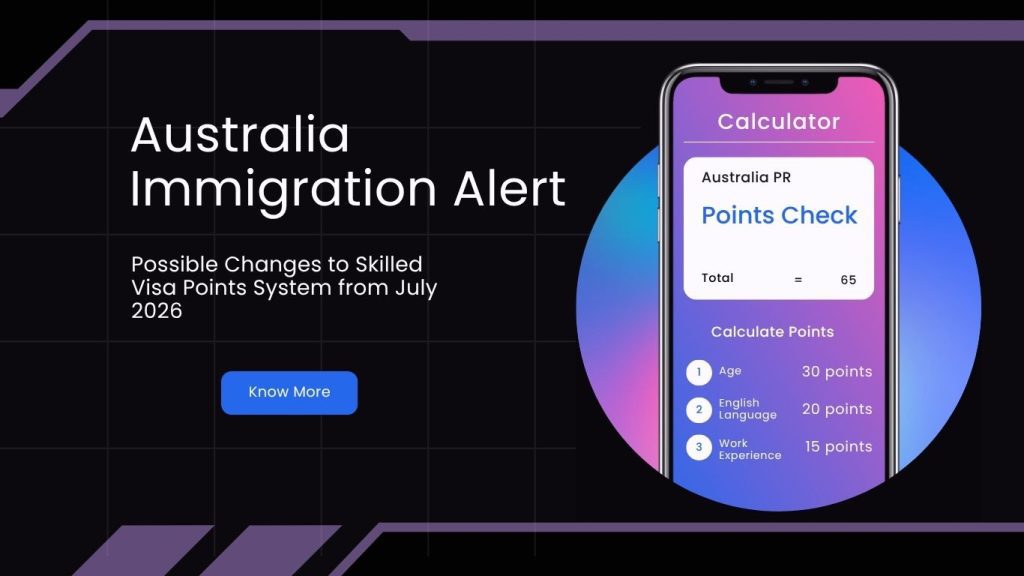
Executive Summary: Australia’s skilled migration points system may be heading toward its most significant overhaul in decades. Political pressure over rising migration numbers, combined with growing calls for a more economically targeted immigration framework, has intensified discussions around a possible reformed points-based system starting as early as 1 July 2026. Key visa pathways — including the Subclass 189 Skilled Independent Visa and the Subclass 491 Skilled Work Regional Visa — could be directly affected. While no official confirmation has been made by the Department of Home Affairs, the direction of policy debate is clear enough that every skilled migrant should be reviewing their strategy right now. This article covers the political context, proposed changes, visa-specific impacts, the likely timeline, and what you should do before any reform takes effect.
If you are a skilled worker planning your pathway to Australian permanent residency, the next few months may be among the most consequential in recent immigration history. Discussions about revising Australia’s points-based skilled migration system have moved beyond policy circles and into active political debate — and with a potential start date of 1 July 2026 being widely referenced, the window for planning under the current rules may be shorter than many applicants realise.
This is not a confirmed change. The Department of Home Affairs has not announced a new system. But when political pressure, economic research, and policy commentary all align in the same direction — and when a specific date is repeatedly cited — waiting to see what happens before acting is a strategy with real risk. The applicants who fare best through any transition period are the ones who are already prepared before the rules change, not those scrambling to adapt afterward.
Here is everything you need to understand about what is being discussed, why it matters, and what to do about it.
Political Pressure on Australia’s Immigration System
Australia’s immigration debate has intensified significantly over the past eighteen months. Net overseas migration reached a record 518,000 in the 2022–23 financial year — a figure that generated sustained media attention, parliamentary debate, and measurable public concern about pressure on housing, infrastructure, and public services. Both major political parties have responded by signalling a commitment to more carefully managed migration levels going forward.
For skilled migration specifically, the political conversation has shifted from whether to reform the system toward how to reform it. The question being actively debated is not whether Australia should continue to welcome skilled migrants — the workforce evidence makes that necessity clear — but whether the current points-based framework is selecting the right skilled migrants in the right way.
Critics of the current system argue that it can reward credentials without ensuring economic contribution. A migrant can accumulate a competitive points score through a combination of age, an Australian qualification, and a modest English result — without demonstrating that their skills address a genuine workforce need. Proponents of reform argue that a revised system should weight economic productivity, occupation-specific shortage, and demonstrated employer demand more heavily than the current framework does.
This is the political backdrop against which the proposed July 2026 changes are being discussed. It is not abstract policy debate — it is active political pressure with a realistic timeline.
Proposed Changes to the Points-Based Visa System
While no official legislation has been tabled, several reform proposals have been consistently referenced in policy discussions and research publications. Understanding what is being considered helps you assess both the risk to your current strategy and the opportunities a reformed system might create.
Higher weighting for economically productive occupations. One of the central proposals involves recalibrating points allocations to more heavily reward applicants whose occupation addresses a documented, verified workforce shortage. Under this model, a software developer competing in one of the most oversupplied occupation pools in the system would score less favourably than a construction tradesperson or a healthcare professional in a genuinely undersupplied field.
Greater emphasis on skilled work experience over qualifications alone. The current system awards points for qualifications at various levels. A reformed system may shift the balance toward demonstrated skilled employment — particularly Australian employment — as the primary indicator of economic contribution potential. This would benefit applicants who have already built skilled work experience in Australia and disadvantage those relying primarily on academic credentials.
A digital immigration evaluation platform. Policy discussions have referenced the introduction of an updated digital assessment system that would match applicants against real-time labour market data rather than relying on periodic occupation list updates that can lag market conditions by months. This would make the system more responsive and potentially more difficult to game through strategic occupation selection.
Revised and more targeted skills priority lists. Future invitation rounds may concentrate specifically on occupations with verified critical shortages — effectively narrowing the field of eligible applicants for each invitation round. If your occupation sits on the outer edge of the current skilled occupation list, this reform could significantly affect your invitation prospects.
Use the Australia PR points calculator to model your current score under the existing framework and assess how any of these proposed changes might affect your competitiveness. Understanding your current position is the essential starting point for any strategic response to potential reform.
Impact on Skilled Migration Visas — Subclass 189 and Subclass 491
The two visa pathways most directly exposed to the proposed reforms are the ones that rely most heavily on the points test for invitation: the Subclass 189 (Skilled Independent) and the Subclass 491 (Skilled Work Regional).
Subclass 189 — Skilled Independent Visa: This is the most purely points-dependent visa in the Australian system — no employer and no state sponsor required. It is also the most exposed to any reform that tightens the points criteria or narrows the eligible occupation pool. In crowded occupation pools, 189 invitation cutoffs already sit at 85–90 points in some rounds. A reformed system that further concentrates invitations on shortage occupations could make 189 the hardest pathway for applicants in oversupplied fields while potentially accelerating invitations for those in genuine shortage sectors.
Subclass 491 — Skilled Work Regional Visa: The 491 is considered the most reform-insulated of the two pathways. Its regional focus aligns directly with the proposed reforms’ emphasis on directing migration toward areas of genuine economic need. The 15-point bonus it already carries under the current system reflects the government’s existing commitment to regional workforce incentives — and a reformed system is likely to strengthen, not weaken, that incentive structure. The 491 visa requirements — including the commitment to live and work in a designated regional area for three years — remain the primary eligibility threshold, and the occupation-demand logic of a reformed system actually favours regional applicants.
For those working toward permanent resident visa Australia through either pathway, the strategic implication is the same: build your profile under the current rules now, so that you are either invited before any reform takes effect or arrive at any new system with the strongest possible foundation.
The skilled nominated subclass 190 visa — which adds 5 points through state or territory nomination — is also worth considering as a parallel strategy. State nomination introduces a second layer of assessment that operates independently of the federal points test, and in an uncertain reform environment, having a 190 nomination in progress while your 189 EOI sits in the pool is a prudent hedge.
Timeline and Possibility of Reforms in July 2026
The date of 1 July 2026 has been consistently referenced in policy discussions because it aligns with the start of a new Australian financial year — the natural administrative boundary for major policy transitions. However, it is essential to be clear: no official reform has been confirmed, no draft legislation has been published, and the Department of Home Affairs has not announced a new system.
What we can say is that the conditions for reform are present in a way they have not been for many years. Political will exists on both sides of parliament. Economic research from credible institutions supports the case for a more targeted system. The operational infrastructure for a digital assessment platform is being actively developed. And the public appetite for a more deliberately managed immigration program is measurable and consistent.
The honest assessment is that reform is more likely than not before the end of 2026 — but the exact timing, scope, and implementation pathway remain genuinely uncertain. For applicants, that uncertainty itself is the most important reason to act under current rules rather than wait.
There are two categories of outcome to plan for. If reform happens on or around 1 July 2026, applicants who have lodged EOIs, completed skills assessments, and built competitive points profiles before that date will be in the strongest possible position — either already invited under the current system or well-positioned under any reformed one. If reform is delayed or moderated, the same preparation does not disadvantage you in any way. The cost of being prepared is zero. The cost of being caught unprepared by a rule change is potentially significant.
To calculate your current PR points calculation and understand exactly where you stand relative to current invitation cutoffs, do that exercise today rather than next month. Every week of delay in a tie-break-sensitive system has a measurable cost.
Which Occupations Are Best Positioned Regardless of Reform Direction?
The most useful strategic lens for navigating an uncertain reform environment is to identify occupations that are likely to fare well under any realistic version of a more economically targeted points system. These are occupations where genuine shortage is documented, state nomination is active, and employer sponsorship is available — meaning multiple independent pathways to permanent residency exist regardless of how the points test evolves.
Construction trades remain among the most structurally undersupplied occupations in Australia. The federal government’s housing delivery commitment — 1.2 million new homes over five years — creates sustained demand for carpenters, bricklayers, and building construction professionals that no realistic migration reform will reduce. A certificate III in bricklaying, a diploma of building and construction, or a certificate III in carpentry leads to occupations that sit on the skilled occupation list with active state nomination and employer sponsorship available across multiple jurisdictions.
Engineering fabrication and welding roles in mining, civil construction, and renewable energy infrastructure are in similar positions. A certificate III in engineering fabrication trade leads directly to occupations where employer demand is sustained and a reformed system that rewards genuine economic contribution would be likely to favour, not disadvantage.
Healthcare — particularly nursing — is perhaps the most reform-proof sector of all. The structural shortage of qualified nurses in Australia is well-documented, bipartisan in its acknowledgement, and unlikely to resolve through domestic training alone within any realistic timeframe. A diploma of nursing or full nursing qualification remains one of the clearest and most reliable pathways to Australian permanent residency — and any reform that prioritises economic need will only reinforce that position.
Hospitality continues to show strong and sustained demand. A certificate III in commercial cookery leads to cook and chef roles that have been on Australia’s shortage lists for over a decade — across metropolitan restaurants, regional tourism, and aged care catering. Employer sponsorship is actively available, and the Skills in Demand visa (Subclass 482) provides a clear temporary-to-permanent pathway for qualified cooks.
Automotive technology is also gaining relevance as the EV transition creates structural demand for multi-skilled technicians. A diploma of automotive technology positions graduates for roles where state nomination availability is growing and employer demand is increasing.
What the Reform Means for International Students and the Student-to-PR Pipeline
For international students currently studying in Australia or planning to arrive, the proposed reforms carry a specific implication: the qualification you choose today may determine your migration competitiveness under a system that could look quite different by the time you graduate.
Under the current system, an Australian qualification earns you points regardless of the occupation it leads to. Under a reformed system that weights economic productivity and occupation-specific shortage, qualifications in documented shortage fields would carry significantly more migration value than qualifications in oversupplied ones.
Students holding a student visa Australia should be thinking now about how their chosen field aligns with the direction of likely reform — not just whether it meets current points test criteria. The Australia skilled occupation list is the reference point for current occupation eligibility, but in a reformed system the distinction between occupations on the list and occupations in genuine shortage may become more consequential than it currently is.
For graduates transitioning from study to the post-study work pathway, the temporary graduate visa Australia remains the primary bridge between completing an Australian qualification and building the skilled work experience needed for a competitive PR profile. That bridge is still standing — but the cost of crossing it has increased significantly with the March 2026 fee rise, making strategic planning around both the 485 and the subsequent PR pathway more important than ever.
The Employer Sponsorship Option: A Reform-Proof Parallel Strategy
One of the most important but underutilised insights in the proposed reform discussion is that employer-sponsored permanent residency pathways operate largely independently of the points test. If your SkillSelect profile is uncertain — because your occupation is potentially exposed to reform, your points score is borderline, or you are unsure how a new system would treat your specific situation — employer sponsorship provides a parallel pathway that bypasses the points queue entirely.
The employer nomination scheme visa subclass 186 is a direct permanent residence visa available to skilled workers nominated by an Australian employer. The 186 direct entry stream is available for applicants with three years of relevant skilled employment who have employer support. The direct entry stream timeline is independent of SkillSelect invitation rounds — it does not wait for points cutoffs, does not depend on tie-break dates, and is not affected by occupation ceiling pressure in the same way the points-tested stream is.
For skilled workers who have built genuine relationships with Australian employers — through employment, contracting, or industry networking — pursuing the 186 route alongside a SkillSelect strategy is not a backup plan. It is a genuinely parallel pathway to permanent residency that is worth pursuing on its own merits, particularly in an environment where the points test rules may be in transition.
What You Should Do Right Now — A Practical Action Plan
Given the uncertainty around timing and specifics, the most constructive response to the proposed reforms is not to wait and see. It is to strengthen your position under the current system while the rules are known and unchanged — because the fundamentals of a competitive skilled migration profile are unlikely to change dramatically regardless of how the points test is restructured.
Step 1 — Calculate your current points score today. Use the calculate PR points Australia tool to understand exactly where you stand relative to current invitation cutoffs for your occupation. If you are already competitive, lodge your EOI immediately. If you are not yet competitive, identify the specific gaps and the fastest route to closing them.
Step 2 — Check your occupation’s position on the current list. Confirm that your target occupation appears on the relevant Australia skilled occupation list and assess how central it is to Australia’s documented workforce shortage. Occupations in genuine shortage are the most reform-insulated. Occupations in oversupplied pools carry the highest reform risk.
Step 3 — Maximise your points under the current rules. Every factor you can improve now — English score, skilled work experience milestones, Australian study bonus, partner skills claims — builds a stronger profile under the current system and under any reformed one. Improve your English score if you are below Superior. Update your EOI the moment you cross an experience milestone. Do not sit on a stale profile waiting for circumstances to improve on their own.
Step 4 — Assess state nomination and regional options seriously. If your occupation is currently nominated by one or more states, the 190 and 491 pathways may deliver faster outcomes than waiting for a 189 invitation in a potentially reforming environment. The sub class 190 visa adds 5 points and provides state nomination as a second layer of PR pathway security. The 491 adds 15 points and is the most reform-insulated pathway for most occupations.
Step 5 — Talk to a registered migration professional before reform happens. The complexity of navigating a potentially transitioning immigration system — while managing skills assessments, EOI updates, state nomination criteria, and employer sponsorship conversations simultaneously — is exactly the kind of situation where professional guidance delivers direct, measurable value. A migration agent Melbourne who tracks policy developments in real time can give you specific, current advice on your individual profile — not generic information from a website that may not reflect the latest developments.
Frequently Asked Questions: Australia Skilled Visa Points System Changes 2026
Q1. Has the Australian government officially confirmed a new points system from July 2026?
No. As of now, the Department of Home Affairs has not officially confirmed any changes to the skilled migration points test. The July 2026 date and proposed reforms are the subject of active policy discussion and political pressure, but remain unconfirmed. The current system is still in full effect and applicants should continue operating under it while monitoring official updates.
Q2. Which visas would be most affected by the proposed changes?
The Subclass 189 (Skilled Independent) is most exposed because it relies entirely on competitive points ranking through SkillSelect. The 491 family sponsored visa requirements and the Subclass 190 are relatively more insulated because state and territory nomination introduces an independent assessment layer. Employer-sponsored permanent visas like the 186 are largely unaffected by points test changes.
Q3. Should I rush to lodge my EOI before July 2026?
If your profile is competitive under the current rules, lodging your EOI now is straightforward good practice regardless of potential reform. If your profile is not yet competitive, the priority is to improve it as quickly as possible — not to lodge a weak EOI that will not receive an invitation before any transition. Use the pr points calculator to determine your current competitiveness before deciding.
Q4. Will trades and healthcare occupations still be competitive under a reformed system?
Almost certainly yes. Any reform that prioritises genuine economic need and documented workforce shortage is likely to favour precisely these occupations. Construction trades, nursing, engineering fabrication, and hospitality all address structural shortages — the kind of alignment a productivity-focused points test is designed to reward.
Q5. What is the best visa pathway if I am unsure about reform risk?
Running multiple strategies simultaneously is the most risk-managed approach. Keep your SkillSelect EOI active for 189 if competitive, pursue state nomination (190 or 491) if your occupation and location fit a state’s criteria, and have a conversation with your employer about sponsorship (482/186) if that relationship exists. Depending on a single pathway in an uncertain environment is unnecessary when alternatives are available.
Q6. Where can I find the most current official information?
The Department of Home Affairs website (homeaffairs.gov.au) is the only authoritative source for confirmed policy changes. The SkillSelect invitation round outcomes page publishes cutoff data after each round. State government migration websites publish current nomination program information. For personalised guidance on your specific profile, consult an immigration agent Melbourne who monitors these sources professionally.
Disclaimer: This article is for general informational purposes only and does not constitute legal or migration advice. The proposed reforms discussed have not been officially confirmed by the Australian Government. Immigration policy, occupation lists, and visa requirements are subject to change. Always verify current information with the Department of Home Affairs or a MARA-registered migration agent before making decisions.
Read Next –
Australia State Nomination 2026: When Strategic Pivoting Beats Waiting for 190/491 Pathways
South Australia Opens Doors: 364 Skilled Migration Invitations Released in February 2026
Australia Takes In Record Number of Migrants – What the Numbers Really Mean for You in 2026
Do You Need a Skills Assessment for Your Subclass 482 Visa? Here’s What You Must Know