Executive Summary
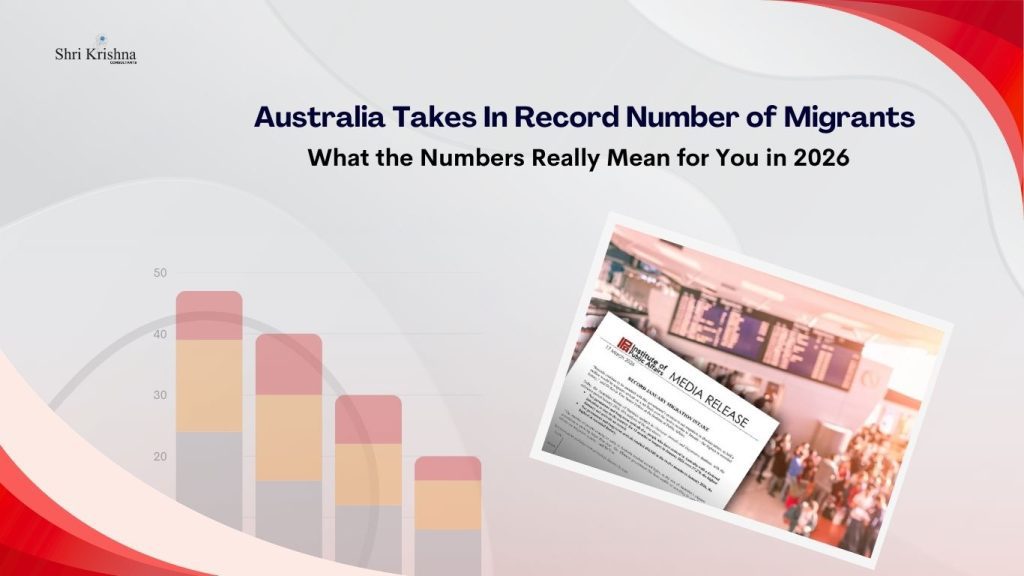
Australia migration figures have hit unprecedented levels, with nearly 1.3 million net overseas migrants arriving in the three full financial years of the current federal government — equivalent to approximately 1,160 people every single day. In January 2026 alone, net permanent and long-term arrivals reached 57,270 — the highest monthly figure ever recorded. Despite Prime Minister Anthony Albanese’s government claiming it reduced net migration by over 40 per cent, Home Affairs data shows 2.98 million temporary visa holders were residing in Australia on 1 January 2026 — the highest number on record. The surge is driven primarily by international students and temporary skilled workers, and is placing intense pressure on housing, infrastructure, and public services. For skilled migrants, students, and families navigating this environment, understanding exactly how the system works — and where the opportunities lie — has never been more important.
Table of Contents
- The Numbers That Shocked Australia
- What “Net Migration” Actually Means — and Why It Matters
- How Did We Get Here? The COVID Rebound Effect
- The Government’s Position — and the Controversy Around It
- Home Affairs Data — What Official Sources Are Actually Saying
- Who Is Coming to Australia? A Breakdown by Visa Type
- The Housing Pressure and Cost of Living Reality
- What This Means for Skilled Migrants Seeking PR
- What This Means for International Students in Australia
- Australia’s Migration Data — The Key Numbers
- What the Future of Australian Migration Looks Like
- How Shri Krishna Consultants Can Help You Navigate This
- Frequently Asked Questions (FAQs)
- Final Thoughts
1. The Numbers That Shocked Australia
When the Australian Bureau of Statistics released its latest overseas migration data, it confirmed what critics of the current federal government had been arguing for months: Australia’s migration intake has been running at historically unprecedented levels, and the gap between political promises and statistical reality is significant.
In the 12 months leading up to January 2026, net permanent and long-term arrivals totalled 494,540 — the highest annual figure ever recorded in Australia’s history. To put that in context, in the entire five years before the COVID-19 pandemic, Australia averaged approximately 515,000 migrant arrivals per year in total. The country is now exceeding that in a single metric alone.
In January 2026 specifically, net permanent and long-term arrivals hit 57,270 in a single month — once again, a record. These are not tourists or short-term visitors. These are people who have declared their intention to remain in Australia for 12 months or longer.
Over the three full financial years of the current government, net overseas migration totalled approximately 1.27 million people. That is the highest three-year total in recorded Australian history, and it works out to roughly 1,160 people arriving on a net basis every day — day after day, without interruption.
These numbers matter not just as political talking points but as practical realities that affect housing costs, visa processing times, infrastructure capacity, and the lived experience of the millions of people — Australians and new arrivals alike — who call this country home.
2. What “Net Migration” Actually Means — and Why It Matters
Before diving deeper, it is worth being precise about terminology — because the political debate around Australia’s migration numbers has been muddied significantly by the use of different metrics that measure different things.
Net overseas migration (NOM) is the figure used by the Australian Bureau of Statistics. It is calculated as migrant arrivals minus migrant departures, where a “migrant” is defined as someone residing in Australia for 12 months or more within a 16-month reference period. This is the most comprehensive and widely cited measure of Australia’s long-term population change from migration.
Net permanent and long-term arrivals is a slightly different measure used by the Department of Home Affairs, based on departure card and arrival card data. It captures people who have declared an intention to remain in Australia for 12 months or more. This is the measure that showed 57,270 arrivals in January 2026 alone.
The distinction matters because the government has periodically pointed to decreases in one measure while the other continues to climb. When Prime Minister Albanese cited a 40 per cent reduction in net migration during Question Time in early March 2026, he was referring to the annual net overseas migration figure, which did fall from its peak of 556,000 in the year ending September 2023 to approximately 306,000 in 2024-25. That is a genuine reduction.
However, critics point out that this framing obscures the bigger picture. Even at 306,000, net overseas migration in 2024-25 was still higher than any annual figure recorded before the post-COVID surge began. And the total cumulative migrant population in Australia — the number of people currently on temporary visas, permanent visas, or in the process of settling — continues to grow to record levels.
As of 1 January 2026, Home Affairs data confirmed 2.98 million temporary visa holders were residing in Australia — a 4.24 per cent increase from the previous year, and the highest figure on record. The debate, then, is not really about whether migration has slowed. It is about whether the rate of slowdown is fast enough, and whether the infrastructure, housing supply, and social services exist to support the population Australia already has.
3. How Did We Get Here? The COVID Rebound Effect
Understanding the current migration situation requires understanding what happened during and after the COVID-19 pandemic — because the record numbers of the past three years cannot be explained without that context.
When Australia closed its international borders in March 2020, the country entered a period of historically low migration. In 2020-21, net overseas migration was actually negative — more people left Australia than arrived, for the first time since World War I. International students went home. Temporary workers departed. Skilled migrants who had been planning to arrive couldn’t get here.
When borders reopened to most travellers in February 2022, Australia experienced what economists and demographers describe as a catchup effect. Hundreds of thousands of people who had deferred their plans to come to Australia — students who had deferred enrolment, skilled workers who had been waiting for visa processing, family members waiting to join settled relatives — all moved at roughly the same time. The result was a surge in arrivals that pushed net overseas migration to a record 556,000 in the year ending September 2023.
Since then, the figures have been declining — but from that extraordinary peak. The question of whether the current government’s policy settings accelerated, managed, or simply observed this rebound is genuinely contested, and the answer is probably some combination of all three.
What is not contested is the cumulative effect: in three years, Australia’s permanent and long-term migrant population grew by approximately 1.27 million people on a net basis. Infrastructure, housing supply, and public services that were not built to accommodate that rate of growth are now feeling the strain.
4. The Government’s Position — and the Controversy Around It
The Albanese government’s position on migration has evolved considerably since the post-COVID surge became politically prominent. In the 2023-24 Federal Budget, the government set a net overseas migration target of 235,000 for 2024-25 — a significant reduction from the post-COVID peaks — and introduced a series of policy measures aimed at reducing the volume of international students and temporary visa holders.
These measures included tightening the Genuine Student requirement for international student visa applicants, introducing stricter English language requirements for certain visa categories, capping international student enrolments at individual universities, and reducing the number of student visa grants processed in certain priority periods.
A Home Affairs spokesman confirmed in early 2026 that the government’s migration policies had contributed to the reduction in net overseas migration from its peak, with the 2024-25 figure of approximately 306,000 representing a material decrease from the prior year’s 429,000. The spokesman indicated that the government remains committed to bringing migration back toward its longer-term sustainable level of approximately 235,000 to 260,000 per year.
However, the Institute of Public Affairs and other commentators have challenged the framing of this as a policy success, arguing that the total stock of migrants in Australia — the cumulative number of people on temporary and permanent visas — continues to reach record levels even as the annual flow rate decreases. The distinction between flow (how many people arrive each year) and stock (how many migrants are currently in Australia) is central to this debate.
The political reality is that migration has become one of the defining issues of Australian politics in 2026, with housing affordability, cost of living, and infrastructure pressure all connecting back to population growth in ways that are felt daily by ordinary Australians and new arrivals alike.
5. Home Affairs Data — What Official Sources Are Actually Saying
For those navigating the Australian migration system — whether as a skilled migrant seeking permanent residency, an international student on a student visa, or a family member trying to join a settled relative — the most important data comes from official government sources rather than from political commentary on either side.
According to the Department of Home Affairs, as of 1 January 2026, there were 2.98 million temporary visa holders residing in Australia. The largest categories included:
Student visa holders (Subclass 500) and their dependants, who collectively represent the largest single cohort of temporary migrants in Australia. Temporary skilled workers on a range of employer-sponsored and skills-based visa subclasses. Working Holiday Makers on Subclass 417 and Subclass 462 visas, though these numbers have begun normalising after the post-COVID surge. Bridging visa holders — people who are in Australia while a visa application is being processed or reviewed.
The Australian Bureau of Statistics confirmed that in 2024-25, the largest group of migrant arrivals was international students, with 157,000 student visa arrivals representing nearly half of all temporary visa arrivals during the year. India and China remained the top two source countries by volume, though migration from India and China was lower in 2024-25 than in the prior year, while migration from the United Kingdom and New Zealand increased.
The median age of migrant arrivals was 26 years — reflecting the predominantly student and early-career profile of the migrant cohort — compared to a median departure age of 30 years.
6. Who Is Coming to Australia? A Breakdown by Visa Type
Understanding the composition of Australia’s migrant intake is important for anyone trying to assess what the numbers mean for visa policy, housing, and social infrastructure — and for anyone navigating the system themselves.
The broad categories of migrant arrivals in Australia break down into three main streams: temporary visa holders, permanent visa holders, and Australian and New Zealand citizen arrivals and returns.
International students remain the single largest driver of temporary migration. In 2024-25, 157,000 student visa arrivals were recorded — close to half of all temporary visa arrivals. Australia has actively marketed itself as a world-class education destination, and demand from India, China, South East Asia, and South Asia remains strong. For these students, understanding their pathway from student visa australia to permanent resident eligibility australia is one of the most significant planning exercises they undertake.
Temporary skilled workers arrive under a range of employer-sponsored and skills-assessed visa pathways. The employer nomination scheme remains a central pillar of skilled migration, with the employer nomination scheme visa providing a direct pathway for workers in occupations on the skilled occupation list to transition from temporary to permanent residency.
Working holiday makers on the 462 visa and related subclasses form another significant cohort. Their departures have more than doubled for two consecutive financial years, reflecting the normalisation of the post-COVID backpacker surge.
Family stream migrants — including partners, children, and parents of Australian citizens and permanent residents — form a significant and consistent component of the permanent migration program. The permanent partner visa and family-sponsored pathways continue to operate alongside the skills stream.
7. The Housing Pressure and Cost of Living Reality
No discussion of Australia’s record migration figures is complete without acknowledging the direct and documented impact on housing affordability and cost of living — because this is where the abstract statistics become concrete daily realities for millions of people.
The connection is straightforward. When significantly more people arrive in a country than new dwellings are built to house them, rental vacancy rates fall, rents increase, and housing prices are pushed higher by demand pressure. In 2024 alone, net permanent and long-term arrivals were approximately 444,480, while housing approvals for the same period were only 170,719 — roughly 38 per cent of the arrival figure.
This gap between population growth and housing construction has been documented and discussed extensively. Diana Mousina, Deputy Head Economist at AMP, summarised the situation concisely when she noted that the pace of immigration was simply not compatible with the level of housing supply available, and that without sufficient construction to match population growth, the rental market would continue experiencing upward pressure that feeds directly into inflation.
For new arrivals — whether international students searching for affordable student accommodation in Melbourne or Tarneit, skilled workers settling in Point Cook or Williams Landing, or families relocating from India or other parts of South Asia — the housing challenge is not theoretical. It is experienced immediately upon arrival.
This reality does not diminish the value of migration to Australia — economically, socially, or personally. But it does mean that new arrivals need to plan carefully, set realistic expectations about housing costs, and ideally connect with advisers who understand both the migration system and the practical realities of settling in Australia’s major cities.
8. What This Means for Skilled Migrants Seeking PR
For skilled migrants who are either already in Australia or planning to come, the record migration environment creates both challenges and opportunities — and understanding both is essential for effective planning.
The challenges are primarily around increased competition for skilled migration spots and state nomination places. When more people are in Australia on temporary visas, more people are competing for the same permanent residency pathways. Processing times for some visa categories have increased. State nomination programs have become more competitive, with points score thresholds rising in response to higher applicant volumes.
At the same time, the sustained demand for skilled workers in specific sectors remains strong. The australia skilled occupation list continues to reflect genuine workforce shortages in healthcare, construction trades, engineering, and information technology — and occupations on this list retain access to skilled migration pathways even in a tighter environment.
For migrants using a pr calculator australia to assess their chances, understanding the current competitive landscape means knowing not just your own points score but the typical invitation rounds for your occupation and state nomination preferences. The australia pr points calculator tools available can give you a starting assessment, but the real planning work happens in consultation with a registered migration agent who understands current Department of Home Affairs processing priorities.
Key pathways for skilled migrants in 2026 include the Subclass 189 (independent points-tested), the sub class 190 visa (state nominated), the 491 visa requirements pathway for regional migration, and employer-sponsored routes including the 186 direct entry stream.
For graduates who have completed their studies and are on a 485 temporary graduate visa, the post-study period is a critical window for accumulating work experience, improving points scores, and positioning for a permanent visa application. This window should be used strategically, not allowed to pass without a clear plan.
9. What This Means for International Students in Australia
International students are, according to ABS data, the single largest cohort driving Australia’s current migration figures. This creates a complex dynamic: the government is simultaneously marketing Australia as a world-class study destination and implementing policies designed to reduce the volume of student visa grants.
For students currently in Australia or planning to come, the most important practical implication of the current environment is the increased scrutiny around student visa applications. The Genuine Student requirement — which assesses whether the primary purpose of coming to Australia is study — is being applied more rigorously. English language requirements have been tightened for certain categories. And university enrolment caps are affecting the availability of offers from certain institutions.
Understanding student visa subclass 500 conditions — including the student visa 500 working hours limits, OSHC requirements, and academic progression expectations — is non-negotiable for maintaining visa compliance in this environment.
For students planning their pathway from study to permanent residency, the route requires careful course selection, skills assessment planning, and understanding of how the transition from student visa australia to temporary graduate visa australia to permanent visa actually works in practice.
The permanent residency courses in australia that support the strongest migration outcomes are those aligned with genuine occupational demand — not simply those with the easiest entry requirements or the lowest fees. Choosing the right course is often the single most important migration planning decision an international student makes, and it deserves far more careful consideration than it typically receives.
For students in Melbourne’s western suburbs — including those based in Werribee, Tarneit, Point Cook, Hoppers Crossing, and Williams Landing — local, accessible advice from a migration agent near me who understands both the national policy environment and the local study and work landscape makes a genuine practical difference.
10. Australia’s Migration Data — The Key Numbers
| Period | Net Overseas Migration | Key Context |
|---|---|---|
| Pre-pandemic average (5yr) | ~515,000 arrivals/yr total | Stable, managed migration levels |
| 2020–21 | Negative (net population loss) | Border closures — COVID-19 |
| 2022–23 | ~536,000 net | Post-COVID border reopening surge |
| Year ending Sept 2023 | ~556,000 net (all-time peak) | Highest single-year figure on record |
| 2023–24 | ~429,000 net | First year of decline from peak |
| 2024–25 | ~306,000 net | Second consecutive year of decline |
| Jan 2026 (single month) | 57,270 net permanent/long-term | Highest monthly figure ever recorded |
| 12 months to Jan 2026 | 494,540 net permanent/long-term | Highest 12-month figure on record |
| Total under current govt (3 FY) | ~1.27 million net | Highest 3-year total on record |
Net Overseas Migration to Australia — Year by Year Trend
| Year | Net Overseas Migration | Note |
|---|---|---|
| 2018–19 | 239,000 | Pre-pandemic stable level |
| 2019–20 | 194,000 | Pre-pandemic — slight decline |
| 2020–21 | -85,000 | NEGATIVE — COVID borders closed |
| 2021–22 | 171,000 | Borders reopening — slow recovery |
| 2022–23 | 536,000 | Post-COVID surge begins |
| Year ending Sept 2023 | 556,000 | ALL-TIME PEAK |
| 2023–24 | 429,000 | First year of decline from peak |
| 2024–25 | 306,000 | Second consecutive year of decline |
Source: Australian Bureau of Statistics, Overseas Migration 2024–25
| Visa Category | 2024–25 Arrivals | Trend vs Prior Year | PR Pathway |
|---|---|---|---|
| International Students (Subclass 500) | 157,000 | ↓ Decreasing | Via 485 → Skilled migration |
| Temporary Skilled Workers | Part of 363,000 temp total | ↓ Decreasing | Via 482 → 186 / 189 / 190 |
| Working Holiday (417/462) | Significant but normalising | ↑ Departures rising fast | Limited direct PR pathway |
| Permanent Skilled (189/190/491) | ~90,000–95,000 grants | Stable | Permanent on grant |
| Family Stream | Consistent | Stable | Permanent on grant |
| New Zealand Citizens (SCV) | Higher than prior year | ↑ Increasing | Special pathway post-2022 |
11. What the Future of Australian Migration Looks Like
The trajectory of Australian migration in 2026 and beyond depends on several intersecting factors: government policy settings, global demand for Australian education and work opportunities, housing construction rates, and the broader economic context.
The government has stated its intention to bring net overseas migration back toward a sustainable long-term level of approximately 235,000 to 260,000 annually. The ABS projects net overseas migration of approximately 260,000 in the 2025-26 financial year, suggesting the trajectory is moving in that direction — though whether it arrives there, and stays there, remains to be seen.
The vetassess skill assessment process and skills assessment frameworks are under ongoing review, with the government working to ensure that the skills Australia accepts through migration actually align with genuine workforce gaps rather than simply meeting numerical targets.
One clear direction in policy is a greater emphasis on regional migration — encouraging new arrivals to settle in regional Australia rather than concentrating in Melbourne, Sydney, and Brisbane. The 491 family sponsored visa requirements and regional nomination programs are designed to support this, with regional employers and state governments actively competing for skilled migrant workers to fill gaps that metropolitan labour markets are not experiencing in the same way.
For Indian students and skilled migrants specifically — who represent one of the largest and fastest-growing cohorts — the pathway from India to Australian permanent residency through study and work remains among the most viable and well-supported in the world. PR in Australia from India is achievable, but it requires careful planning, the right course or occupation selection, and advisers who understand both the Australian and Indian sides of the equation.
The UN data showing that nearly one in three Australian residents was born overseas — placing Australia among the top countries globally for the share of foreign-born residents — is not just a migration statistic. It is a statement about what Australia is: one of the most genuinely multicultural societies on earth, built on and by migration over more than two centuries.
That character is not changing. What is changing is the pace, the planning, and the infrastructure needed to support it well.
12. How Shri Krishna Consultants Can Help You Navigate This
For anyone navigating Australia’s migration system in this environment — whether you are an international student in Melbourne’s western suburbs, a skilled professional assessing your PR pathway, a family trying to reunite, or an employer trying to sponsor a worker — the complexity and the stakes are both significant.
At Shri Krishna Consultants, our team of australian registered migration agents provides clear, personalised, and up-to-date advice on every aspect of the Australian migration system. Whether you need a migration agent near me who understands the local landscape in Werribee, Tarneit, Point Cook, Hoppers Crossing, or Williams Landing, or you need expert guidance from India on how to apply for Australian student visa from India — we are here.
Our services cover the full migration spectrum:
Student visas and compliance — Understanding your australian student visa conditions, managing student visa extension australia applications, and planning your course and study pathway with an eye on the migration outcomes you actually want.
Skilled migration and PR — From calculating your australia pr points calculation and choosing the right visa pathway, through to lodging your application and navigating the invitation process.
Employer sponsored visas — Supporting employers and employees through the employer nomination scheme visa subclass 186 process, temporary skill shortage applications, and the transition from temporary to permanent residency.
Graduate visas — Making the most of your post-study window through the 485 temporary graduate visa and planning your onward pathway to PR.
Family visas — Reuniting families through partner visas, sponsor family visa australia applications, parent visas, and dependent visa processing.
If you are in India and wondering how to begin — or if you are already in Australia and feeling uncertain about your next step — reach out to Shri Krishna Consultants today. As your trusted best migration consultant in Melbourne, we provide the guidance you need to make the right decisions at the right time.
13. Frequently Asked Questions (FAQs)
How many immigrants will Australia take in 2026?
The Australian Government has set a net overseas migration target of approximately 235,000 to 260,000 for 2025–26, down significantly from the all-time peak of 556,000 in the year ending September 2023. The ABS projects the final figure for 2025–26 will land around 260,000.
Who are the top 3 countries migrating to Australia today?
India, China, and the United Kingdom consistently rank as Australia’s top three source countries for both temporary and permanent migrants. India has surpassed China as the largest single source of skilled and student visa arrivals in recent years.
Is Australia taking more immigrants?
Annual net overseas migration has actually been declining since its post-COVID peak — falling from 556,000 in 2022–23 to approximately 306,000 in 2024–25. However, the total number of migrants currently living in Australia reached a record 2.98 million temporary visa holders in January 2026, meaning the cumulative migrant population continues to grow even as the yearly intake slows.
Where in Australia has the least immigrants?
Regional and remote areas of Australia — particularly Tasmania, the Northern Territory, and rural parts of South Australia and Western Australia — have the lowest concentrations of overseas-born residents. This is precisely why the federal government actively promotes regional migration pathways such as the Subclass 491 visa to encourage new arrivals to settle outside the major capital cities of Melbourne, Sydney, and Brisbane.
Q: Has Australian migration actually fallen under the current government? The annual net overseas migration figure has fallen from its peak of 556,000 in the year ending September 2023 to approximately 306,000 in 2024-25. However, the total stock of migrants in Australia — those currently on temporary visas — reached a record 2.98 million in January 2026. Both statements are true simultaneously, which is why the debate is genuinely complex.
Q: Will the migration slowdown affect my visa application? It depends on your visa category. Skilled migration invitation rounds have become more competitive as more people compete for the same spots. Student visa applications face increased scrutiny under tightened Genuine Student requirements. Processing times vary significantly by category. Speaking with a best immigration agent melbourne gives you an accurate picture of what to expect for your specific situation.
Q: What is the fastest pathway from student visa to PR in Australia? The most efficient pathway typically runs: Subclass 500 (student visa) → Subclass 485 (temporary graduate visa) → Subclass 189 or 190 (permanent skilled visa) or Subclass 186 (employer nomination). The total timeline varies from 3 to 8 years depending on occupation, English scores, age, work experience, and state nomination availability. Proper planning from the start of your studies is essential.
Q: Is it true that PR is harder to get now because of record migration? Harder in some categories, yes. More people competing for the same state nomination places has pushed invitation thresholds higher in some states and occupations. However, certain occupations on the skilled occupation list in high-demand sectors — healthcare, construction, engineering — remain accessible with well-prepared applications.
Q: What are the visa options for Indian students wanting to come to Australia? Indian students typically apply for the Subclass 500 student visa, which requires IELTS or equivalent, a valid COE from a CRICOS-registered institution, financial capacity, and meeting the Genuine Student requirement. From there, the 485 visa english requirements and the post-study work rights pathway provide a clear route toward permanent residency. For detailed guidance, contact a student visa consultant near me at Shri Krishna Consultants.
Q: Can I get PR in Australia if I came on a working holiday visa? The working holiday visa (Subclass 417 or subclass 462) does not directly lead to permanent residency. However, time spent in Australia on a working holiday can contribute to skills development, employer relationships, and English language experience that supports a subsequent skilled migration application. A migration agent melbourne can assess your individual circumstances and identify the best onward pathway.
Q: What is the 186 visa processing time currently? Processing times for the Employer Nomination Scheme Subclass 186 visa vary depending on the stream (direct entry or temporary residence transition) and current Department of Home Affairs workloads. In 2025-26, direct entry applications have been taking 12 to 18 months in many cases. Your employer and migration agent need to plan accordingly.
Q: Is the sub 190 (skilled nominated) visa still available for all occupations? The Subclass 190 visa is available for occupations on the relevant state and territory occupation lists — which differ from the national skilled occupation list. Availability varies significantly by state. Some states are actively nominating in healthcare and construction trades; others have closed certain occupations. A current assessment from a registered agent is essential before planning around this pathway.
14. Final Thoughts
Australia’s record migration figures are simultaneously a testament to the country’s enduring appeal as a destination for students, skilled workers, and families — and a genuine challenge for the infrastructure, housing, and policy systems that must serve that growing population.
For the individuals and families behind those statistics — people who have made enormous sacrifices to be in Australia, who are studying hard, working long hours, saving carefully, and planning meticulously for a future here — the numbers are not abstractions. They are life decisions of the most personal kind.
Navigating those decisions well — choosing the right course, understanding your visa conditions, timing your PR application strategically, selecting the right pathway for your occupation and circumstances — is exactly what Shri Krishna Consultants is here to help with. We work with immigration consultant near me clients from across Melbourne’s western suburbs and with students and families in India planning their Australian journey.
Contact us today for an honest, personalised assessment of your migration pathway. The numbers are complex. Your path doesn’t have to be.
Sources: Australian Bureau of Statistics (Overseas Migration 2024-25); Department of Home Affairs (Migration Program Statistics); ABS National, State and Territory Population data. All migration statistics are cited from official Australian government data sources.
Read Next
Australia Immigration Alert – Possible Changes to Skilled Visa Points System from July 2026
Australia State Nomination 2026: When Strategic Pivoting Beats Waiting for 190/491 Pathways
South Australia Opens Doors: 364 Skilled Migration Invitations Released in February 2026